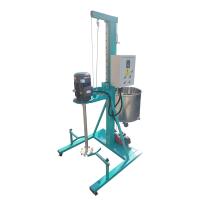
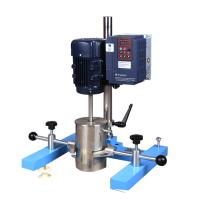
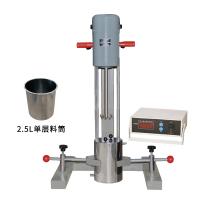
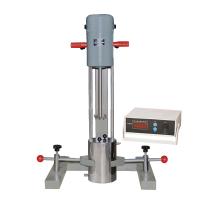
The stability of the coating is an important indicator to measure the quality of the casting coating. Poor coating stability generally refers to deterioration of suspension stability and rheological properties. To ensure the suspension stability of the paint, it is necessary to add a suitable suspending agent. A good suspending agent can effectively prevent the precipitation of refractory aggregates and the excessive penetration of solvents into the mold (core) sand, which is especially important for alcohol-based pouring coatings. After laboratory process tests, we chose a magnesium silicate clay as the suspending agent. Since its swelling mechanism in alcohol solvents is different from that of ordinary organic soils, stronger stirring is required to disperse the soil particles evenly. The needle-like crystal bundles are dismantled to form a messy grid. The grid binds the liquid and increases the viscosity of the system, so that the refractory aggregate can be better suspended in the solvent.


Figure 2 Schematic diagram of the shaft structure of the high-speed disperser
Most of the commonly used high-speed dispersers adopt a single-axis eccentric shaft structure, as shown in Figure 2a. Considering that in order to disperse the suspending agent more uniformly in the solvent, stronger shear dispersion ability is required, so we chose a double-shaft double-layer cross-type high-speed disperser, whose structure is shown in Figure 2b. Two kinds of high-speed dispersing machines with rotating shaft structures were used to prepare alcohol-based pouring coatings, coating ratio/% (parts by mass): graphite powder 100, suspending agent 2-3, binder 2-4, auxiliary agent 0.5, solvent 30 ~40, observe the suspension stability of the paint, and compare the test results.
It can be seen from Figure 3 that since the double-shaft double-layer cross-type high-speed disperser adopts the structure of double-shaft rotation in the same direction and double-impeller staggered arrangement, the chance of circulating flow and turbulent diffusion of solid particles in alcohol solvent is enhanced. At the same time, a strong shear flow is formed between the two shafts, and the dispersion ability is greatly improved. Not only can the effect of the suspending agent be brought into full play, but also the mixing time for the coating to achieve proper suspension is greatly shortened. The test results show that compared with the single-shaft eccentric shaft structure, the mixing time for the coating to achieve the same suspension stability is shortened by 20% to 25% when using the double-shaft double-layer cross shaft structure. While ensuring the coating process performance, it improves production efficiency.

Figure 3 The influence of the structure of the rotating shaft on the suspension stability of the paint