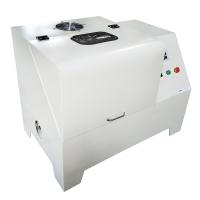
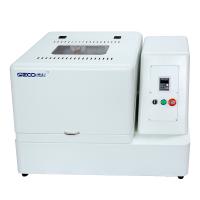
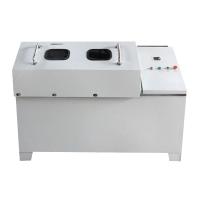
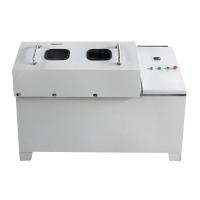
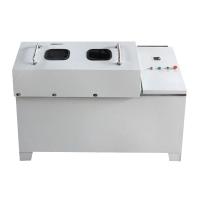
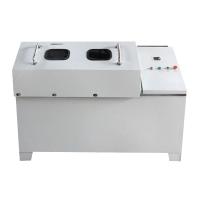
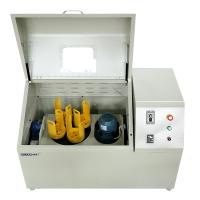
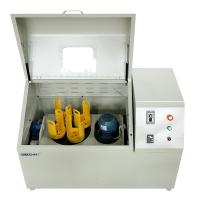
Dispersion preparation generally uses ball mill, sand mill, colloid mill and other equipment. The working principles and characteristics of these three equipment are shown in Table 1-2. Each equipment has its own advantages and disadvantages.
| device name | ball mill | sand mill | colloid mill |
| equipment composition | Racks, milling jars, porcelain balls, or natural pebbles | Cylinder, mixer with blades, glass beads | Rotary disk, fixed shell |
| working principle | The motor drives the ball mill tank to rotate, so that the grinding balls in the tank or between the balls and the tank collide and rub to grind the solid compounding agent finely | The rotation of the electric stirrer makes the glass beads in the cylinder drive the compounding agent to rotate, and the compounding agent is ground between the glass beads or under the impact and friction of the beads and the cylinder | The compounding agent passes through the gap between the high-speed gyratory disc and the fixed shell, and is ground by shearing force |
| features | The dispersion has less impurities, good dispersion effect, low price, and convenient management, but the time efficiency is low and the noise is large. It is suitable for the preparation of dispersions for thin film products | High efficiency, small particles, low sedimentation, compact, simple structure, low noise, but more impurities, poor quality, not suitable for thin products | High efficiency and fine particles, but the efficiency is relatively low, and it is easy to bring in gas, making the dispersion produce many foams |