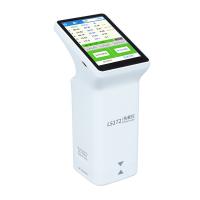
Color Difference (Color Difference) refers to the difference between one color and another color. It is generally represented by the symbol △E. Represented by the distance between two color points in the color space. Its value can be obtained after calculation. In order to make the chromatic aberration numerically consistent and proportional to the human eye's chromatic effect perception, it is reasonable to use isochromatic space coordinates for calculation. Although Zhiling has published many articles on the approximate equichromatic space, there is not yet a satisfactory space that has equichromaticity in the entire space.
In order to illustrate the situation, the following example is very meaningful: for example, there are two pairs of colors, one pair is green, one pair is blue, and the two colors in each pair are different, and its x, y, and Y is similar. Make each pair equal in lightness and saturation, differing only in hue. See the table for their Munsell symbols and CIE values.
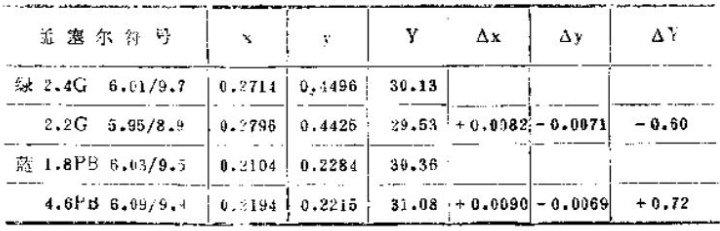
The difference between their hue and saturation (equal brightness) can be seen in the table .

It can easily be seen that the difference between the two colors in each pair is not equal. The average concept after most people's observation and judgment is: the difference between two blue color samples is about 3-4 times of the difference between two green color samples.
It is known from the CIE system that the x, y, z, and tristimulus values measured by the Colorimeter cannot indicate the nature of the color. It needs to be converted into a chromaticity coefficient and drawn on the chromaticity diagram to obtain the dominant wavelength and excitation purity. Therefore, if a batch of ink is prepared according to standard colors, it is difficult to see the difference in dominant wavelength and excitation purity between them.
Human eyes can perceive small differences in color, but instruments are not so sensitive. In order to make the chromatic aberration have a calculation concept, Judd established a chromatic aberration unit—the unit physical quantity when expressing the chromatic aberration numerically. Since the formulas used to calculate the color difference are different, the units are also different. Generally, it is named after the formula for calculating the color difference. For example, the Gottrov color difference formula uses the Gottrov unit, and the Adams color difference formula uses the Adams unit. Git established the NBS (National Bureau of Standard --- American National Bureau of Standards) unit. Generally speaking, as long as the light is good, the slight difference in color that an observer can see is about 0.3 NBS units. The relationship between the color difference value expressed in NBS units and the difference in human perception. see table.

Generally speaking, in industrial applications, a chromatic aberration below one NBS unit is considered an allowable range.
When △E=1, it is called a NBS color difference unit. One NBS color difference unit is approximately five times the just perceptible difference that the human eye can perceive under better experimental conditions. In the CIE chromaticity diagram, one NBS color difference unit is equivalent to a chromaticity coordinate change of 0.0015~0.0025x or y.
Because color space is three-dimensional, a color can differ in three dimensions. In the Munsell system, it is hue, lightness and saturation (color).
The color difference indication should indicate whether the sample is lighter or better than the standard, and the direction of the color difference. Generally, there are two directions for color difference, one is to indicate red or green, and the other is to indicate yellow or blue. Therefore, the color difference is generally expressed in three aspects, namely L (brightness), a (positive numbers are red, negative numbers are green), b (positive numbers are yellow, negative numbers are blue).
Because the total color difference △E of a color can be calculated from a single color difference, so:

In the Munsell chromosphere (color solid), the definitions of L, day, and b can be seen in Figure 18-16. L is the tristimulus value Y, that is, brightness. a and b are related to the chromaticity coefficients x and y. The x , y , and Y values cannot be used to represent color difference directly, since they cannot represent true parallax.
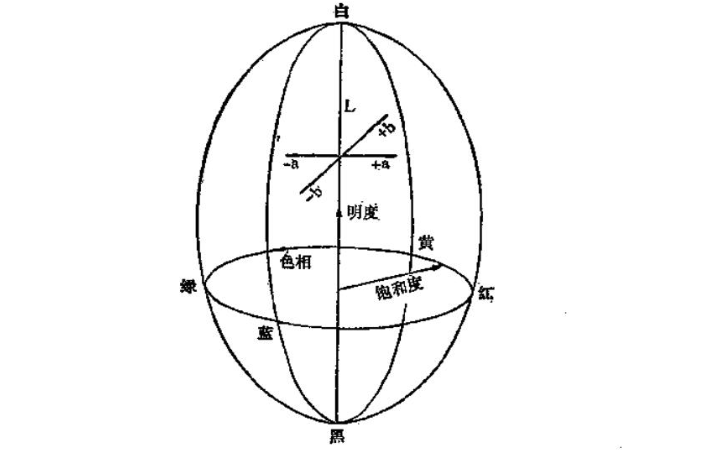
There are many mathematical methods for converting tristimulus values x, y, z into L and b values. This is the mathematical expression of color difference formula 1 to calculate color difference. Since the color space coordinates on which the calculation is based are different, the color difference formulas are also different. But all the color difference formulas have a common purpose, which is to transform the CIE space into a more satisfactory isochromatic space.