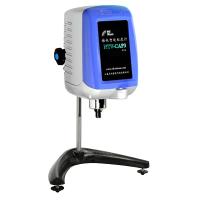
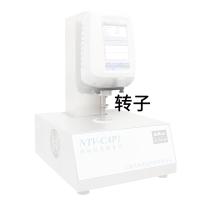
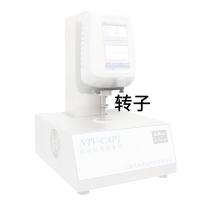
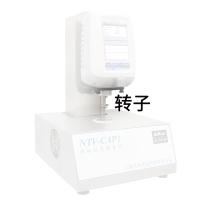
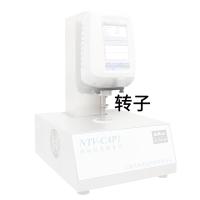
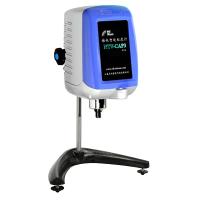
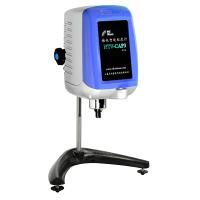
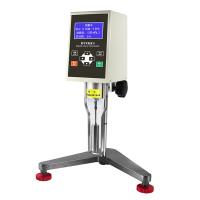
The belt viscometer is actually a parallel plate structure, which is an instrument that uses a thin flat belt (ie moving plate) to pass through a slit formed by a parallel wall (fixed plate) at a constant speed.
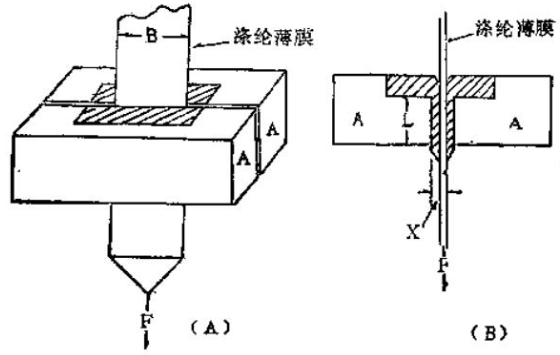
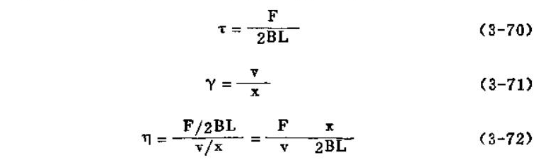
Theoretically, suppose there is an infinitely long belt passing through a slit with speed v, see Figure 19-24. A force F causes the belt to move with a velocity v. The effective area of the strip subjected to shear for a given period of time is 2BL, where B is the width of the strip, L is the length of the slit, and the clearance between the strip and the wall is x . Then the shear stress, shear rate and viscosity of the measured fluid can be calculated from the following formulas:
In fact, the tape (vinyl or polyester film) should be as thin as possible so that edge effects are as small as possible. From a practical point of view, this instrument is only suitable for relatively viscous fluids.
It can be seen from Figure 19-24 (A) that the instrument has two ground metal blocks (fixed plates) that have been ground and separated into parallel planes with metal gaskets for the middle valve, so that the instrument is permanently flat on the two metal blocks. A film of a certain thickness and width is clamped in the narrow section of the development block, and the oil pan is placed in the groove of the metal block A (see Figure 19-24B). The film falls freely with weights of different weights at the lower end of the film, and the viscosity can be calculated by measuring the time for the film to fall for a certain distance.
Both metal blocks are hollow and can be connected with a constant temperature Water Bath to control the temperature of the measured object.
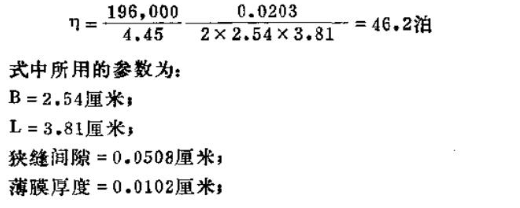
For example, there is a thin piece of 2.54 cm wide and 0.0102 cm thick, which passes through the slit under the pulling force of 200 grams of weight. The width of the slit wall is 5.08 cm, the length is 3.81 cm, and the gap between the slits is 0.0508 cm. The belt was pulled 53.34 centimeters in 12 seconds, then the viscosity of the tested ink can be calculated according to formula 3-72:

The belt viscometer is an instrument specially designed by the National Printing Ink Research Institute of the United States. Due to its large size and relatively high requirements for use, it is rarely used.