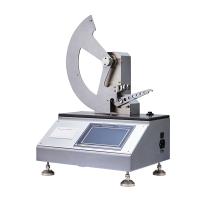
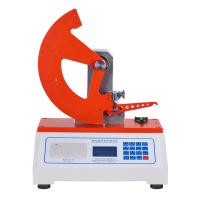
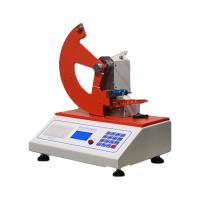
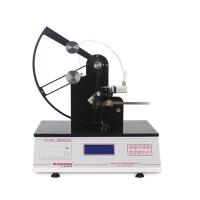
There are many raw materials for synthetic paper, such as polyethylene, polyhelium ethylene, polypropylene, polystyrene, polypropylene glycol ester, polyamide, polyethyl carbonate, etc. Among them, high-density polyethylene is widely used, because its price is very cheap, and its hardness and elasticity are relatively good after film formation, and it has a good lifting effect when it breaks.
The manufacturing principle of synthetic paper is: the first part is similar to the production of plastic film, that is, under certain high temperature conditions, polymer raw materials are melted, extruded, and film-made. Then heat and stretch (extend). The heating stretching (extension) process carried out in the latter part is the so-called "paper-like" treatment.
The pretreatment of polymer raw materials (ie from melting to film making) has long been mature experience. Heating stretching (extension) is the key to the production of synthetic paper, which is to heat the plastic (resin) film to the "softening point" state, and stretch it from two different directions vertically and horizontally by external force (that is, bidirectional stretching process) , and then undergo a rapid cooling treatment to fix the molecular "alignment". When the film reaches the tensile (extension) limit, the size is relatively stable, and the strength (tensile resistance, tear resistance) can also be improved. Generally speaking, the quality of synthetic paper produced by two-way stretching (extension) process is relatively high.
In fact, the heating stretching (extension) process is the molecular arrangement process of the polymer film, that is, the polymer crystals are recrystallized from the molten state and organized into interconnected crystal blocks.
Polymers form crystals from the solution state, which are currently thought to be similar to morphological structures, these volumetric matrix structures include layer upon layer of platelet crystals and form spherical structures. Below the melting point, the orientation of the film or fiber can cause these sheets . The crystalline region interconnects with many elongated fibers.
The presence of intracrystalline fibers greatly increases the mechanical strength of the film because it prevents cracking of the crystal planes.
For synthetic paper, its mechanical properties should be as symmetrical as possible on the plane of the film, so bidirectional stretching (extension) is a better process. By choosing an accurate orientation temperature and stretch ratio, the quality of the finished product must be better than that produced by non-orientation.
Two-way (ie, vertical and horizontal) stretching devices mainly include rolling type and tubular type, and the operation method is divided into one-stage stretching and two-stage two-way stretching (extension). At present, the roll-simplified method is more commonly used in production, because of its low equipment cost and good isotropic balance. However, it has relatively high requirements on the "precision" of the initial film formation, and the magnification of the drawing (extension) example is limited to a certain extent.
Products produced by this process have the following advantages: (1) high mechanical strength and good stiffness; (2) for mixed materials, their internal adhesion can be improved, (3) surface brightness can be improved: ( 4) Improved tear strength; (5) Uniform thickness.
The film obtained after heating and stretching (extension) is smooth and transparent, but it cannot be used for printing, so the so-called "paper-like" treatment is also carried out, which is like turning transparent glass into frosted glass to improve the synthetic paper. Opacity and "ink-wicking" properties. The paper-like processing methods mainly include chemical foaming, embossing, sandblasting, filling (adding titanium dioxide and other fillers), coating, etc.