In the section "Definition of Viscosity", the viscosity coefficient η is mentioned, which generally refers to the viscosity coefficient of Newtonian fluid. When discussing the rheogram, in order to make the concept clearer, we call it the apparent viscosity (Apparent Viscosity).
Apparent viscosity is the ratio of total shear stress to total shear rate at a given shear rate. For example, the two dashed lines in Fig. 19-3, which represent the viscosity of a Newtonian fluid which exhibits the same resistance to flow at a selected shear stress or rate. Its logarithmic shear stress is proportional to the logarithmic shear rate. Its logarithmic apparent viscosity is also directly proportional to the logarithmic shear stress or shear rate.
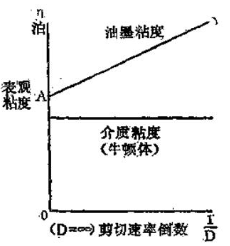
The relationship between the apparent viscosity of the ink in Fig. 1 and the reciprocal of the shear rate
It may be easier to understand the apparent viscosity with the Goodeve and Whitfield theories. Figure 1 shows the relationship between the apparent viscosity of an ink and the inverse of the shear rate. This means that the shear rate at the origin is infinite (limited), and when the structure is completely destroyed, the residual viscosity of the ink can be obtained by extending to an infinite (limited) shear rate A.
It can be seen that point A in the figure is slightly larger than the viscosity of the medium. The value at A here has a certain relationship with the viscosity value of the ink.
Simply put, since the viscosity coefficient η is no longer a constant in non-Newtonian fluids, but changes with the shear rate (or shear stress), therefore, the ratio of r to Y at a certain point on the flow curve can only be taken . The ratio η of r to Y at a certain point on this flow curve is called the apparent viscosity.