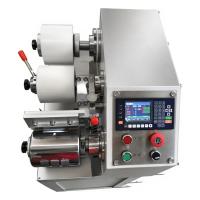
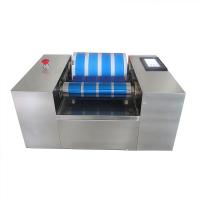
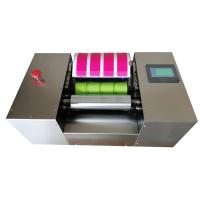
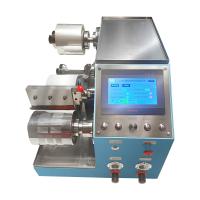
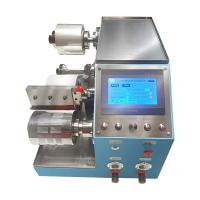
The distribution phase is the distribution (cloth) of the oil on the ink roller of the printing machine, that is, the situation where the ink is transferred from the rubber roller to the metal roller, and then from the metal roller to the rubber roller and so on . It should be noted that the shear stress of the ink on the ink roller system of the printing machine is discontinuous, and due to the vibration of the ink roller, a certain radial and axial shear will also occur.
On the ink roller system of a printing press, the shear stress to which the ink is subjected is very high . According to the basis calculated from the ink viscosity meter data, if the deformation energy of the plastic ink roller is included, the viscosity in the ink is 174 poises during the transfer from one ink roller to another ink roller , and every cubic centimeter The ink can absorb the energy of animal husbandry 2.6-10 9 erg/second .
Part of the energy is used to separate the oil film, and the other part is used to destroy the smooth grain structure in the ink, which is an important function of the printing press distribution system. Most of the energy is converted into heat and consumed.
It is difficult to accurately estimate the shear stress on the ink, but it is about 10 7 dynes/cm2 at a rotational speed of 400 rpm . Since the shearing is discontinuous, and the contact surface (referring to the contact surface between ink rollers) generally does not exceed 5% of the total area. Therefore, it is possible to rebuild the pigment particle structure in the ink. Of course, for a satisfactory ink, the reconstruction of the pigment particle structure within a few seconds is unlikely occur. This happens only when the yield value of the ink is large.
If the solid content in the ink component is relatively high, dilatation is likely to occur under high shear stress , thereby reducing the flow performance, and finally causing the ink to accumulate at both ends to form a pile-up.
The ink must not only wet the rubber roller, but also wet the metal roller well, failure to achieve these goals will inevitably lead to poor distribution. In addition, the transfer of ink to each collapsed roller needs to be proper, which means that it can only be achieved when each transfer separates the ink film into an equal thickness, ie equivalent to a 50% transfer. If the ink viscosity is too high at a certain speed , the transfer will not be satisfactory. Generally , the amount of ink transferred is relatively small, resulting in insufficient ink on the printing plate. Therefore, at a certain speed , the viscosity of the ink in the distribution phase can generally be at the upper limit, and should not be too large.