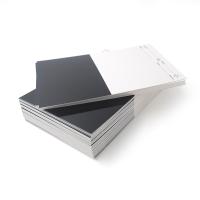
The hiding power of the color paint affects the coating construction in all aspects. For example, low hiding power requires more paint loss, and incomplete hiding affects the appearance; too thick and too long drying time will waste too much time for multiple coats , but also easy to hang. The hiding power of colored paint is mainly the ability of the paint film to absorb, diffuse and reflect light so that the substrate can appear differently.
There are currently three methods for measuring the hiding power of paints.
They are:
(1) Mass per unit area method
(2) Minimum paint film thickness method
(3) Reflectance comparison method
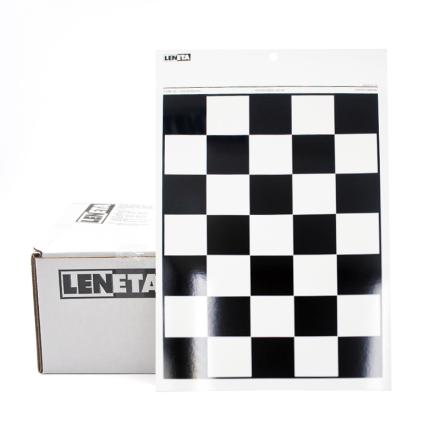
The more commonly used ones are (1) and (2). The former is tested by black and white grid board or black and white grid hiding power test paper, but it is mainly visual inspection. Both ISO and national standards recommend the use of reflectance meters to measure the hiding power of colored paints. Of course, its limitation is that this method is mainly suitable for white paint and light-colored paint.
The method of use is to coat different thicknesses on a transparent polyester film, place it on a black and white glass plate after drying, and measure the reflectance with a reflectance meter to obtain the contrast ratio CR.
CR=R B /R w
R B —— blackboard reflectance
R w ——whiteboard reflectance
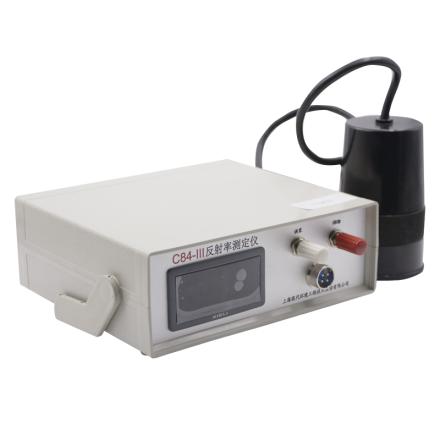
When the contrast ratio is equal to 0.98, it is considered to be fully covered, and the hiding power can be obtained according to the thickness of the paint film. This method is more accurate in judging and can overcome the shortcomings of the above two methods, but the operation is more complicated. CHINA has equivalently adopted the ISO standard, and formulated GB/T 13452.3-1992 "Determination of Hiding Power of Paints and Varnishes - Part: Kubelka-Munk Method for White and Light Paints", which is equivalent to ISO 6504/ 1- 1983 (1989) standard, the measured hiding power refers to the spreading rate when the contrast ratio needs to be 0.98, which is suitable for the pigmented paint film with Y greater than 70 in the tristimulus value, not suitable for fluorescent and metallic paints. It can also measure the contrast ratio at different spreading ratios (m2/L), that is, the corresponding covering ratio.