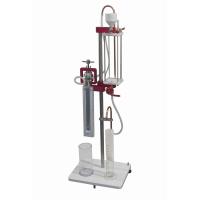
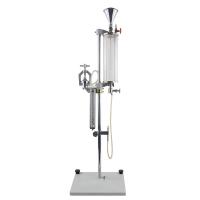
The schopper air permeability meter test method is suitable for paper and cardboard with air permeability between 1×10 -2 ~1×10 2 m/(Pa·s), not for paper and cardboard with relatively rough surface, nor Suitable for papers with very low porosity.
Test Principle
The test principle of the Schopper air permeability meter is to clamp the sample in the sample holder and overflow water from the airtight glass container filled with water to form the pressure difference between the upper and lower sides of the sample. When the pressure difference is stable, the intake air volume is equal to the water flow rate, and the water flow rate (mI/min) within a certain period of time or the time required to overflow a certain volume of water (min/mL) is measured to indicate the air permeability of the sample. Schopper air permeability of paper or paper is:

Schopper air permeability meter
①Structure and working principle
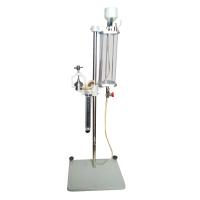
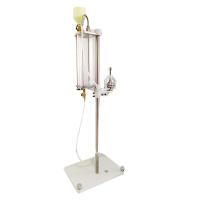
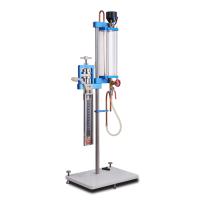
The Schopper air permeability meter is composed of a container, a differential pressure indicator and a vacuum system composed of connecting pipes, as shown in Figure 2-19. Before the test, the sample is clamped between the pressure ring and the air chamber, the container is filled with distilled water, the intubation tube is connected to the air chamber and the container, the valve is opened, and the distilled water in the container is poured into the measuring cylinder through the overflow pipe, and the upper part of the container produces Vacuum, move the overflow pipe, adjust the vacuum degree in the air chamber to 13.332kPa, and make the reading stable. The air flows into the air chamber through the sample, and then enters the vacuum part of the container through the exhaust pipe. The air intake volume is equal to the water flow rate (the pressure difference of the U-shaped tube should be kept at 13.332kPa), and the water is collected with a measuring cylinder, and the unit time is calculated with a stopwatch. The volume of water flowing out is the air permeability of the sample. The schopper air permeability meter has simple structure, convenient maintenance, and technical performance meets the requirements, but it is troublesome to operate.

Figure 2-19 Principle of Schopper air permeability meter
1-Intubation; 2-Air chamber; 3-Sample; 4-Container; 5-Water; 6, 7- Valve ; 8-Overflow pipe
②Main technical parameters
a. Test area: (10±0.05) cm2.
b. Pressure difference: the vacuum degree is 100mmH2O or 200mmH2O.
c. Sample clamp ring and air inner diameter: 35.7mm.
d. Measuring range: 0~1000mL/min.
③ Calibration procedure
a. Check the tightness of the instrument. After the glass container is filled with distilled water, place and clamp the sample, open the drain valve, adjust the pressure difference of the U-shaped tube to 100mmH2O or 200mmH2О, then close the pressure regulating valve, and keep the water column in the U-shaped tube unchanged within 30min.
b. Proofread the measurement area. Take out the upper and lower pressure rings for measurement, the diameter should be 35.7mm, and the area should be (10 ± 0.05)cm².
c. Check the water surface position of the U-shaped differential pressure gauge. Observe whether the two water surfaces in the U-shaped tube are parallel to the zero point.
d. Check whether the upper and lower pressure rings are concentric, whether the valves are flexible, and whether the connections are firm.
Test Methods
According to the national standard GB 458 "Paper and cardboard porosity determination method (Schober method)" to carry out the test. The specific test steps are as follows.
①Sample collection and processing. Sampling according to GB450, cut 10 pieces of 60mm×100mm samples along the transverse direction of the paper web, mark the front and back sides, and perform temperature and humidity pretreatment on the samples according to the requirements of GB 10739.
② Place the sample between the upper and lower pressure rings and clamp it tightly.
③Place a measuring cup under the overflow pipe, open the drain valve, and then slowly adjust the needle-shaped pressure regulating valve to adjust the vacuum to 100mmH2O, that is, the pressure difference of the U-shaped differential pressure gauge is 100mmH2O. If it cannot reach 100mmH2O, it can be adjusted to 50mmH2O or 20mmH2O, but the result should be multiplied by a factor of 2 (for 50mmH2O) or 5 (for 20mmH2O ) .
④ After the pressure difference of the U-shaped tube is stable, start the stopwatch, and at the same time, use a measuring cylinder to receive water. The amount of water accumulated in the measuring cylinder within 1 minute is the air permeability of the sample, and the unit is mL/min.
The test results are expressed as the arithmetic mean of all test results (including positive and negative sides), and can also be converted into international unit report results [1mL/min=1.7×10 -8 m / (Pa·s)=1.7×10 -2 μm /(Pa·s)], take three significant figures. The standard deviation and coefficient of variation should be calculated when necessary.