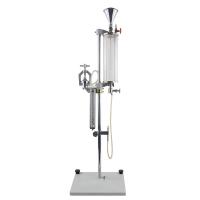
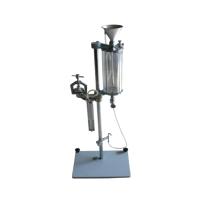
(1) Test principle
The principle of the Gurley method to measure the air permeability of paper and cardboard is that the vertical cylinder floating on the sealing oil is lowered steadily to compress the air in the cylinder and make it pass through the sample, so as to measure the required volume of air to pass through the sample. time, and calculate the air permeability.

The Gurley method is suitable for paper and cardboard with air permeability in the range of 0.1~100um/(Pa s). It is not suitable for rough paper, such as crepe paper or corrugated cardboard, because these cardboards are difficult to clamp and easily cause air leakage. .
(2) Gurley air permeability meter
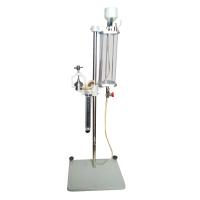
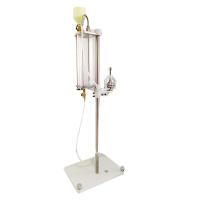
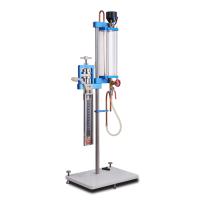
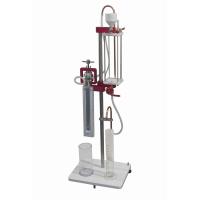
The working principle of the Gurley air permeability meter is: the sample is placed on the sample holder, and the inner cylinder overcomes the buoyancy of the spindle oil and descends, forcing the air to leak through the paper surface. Measure the time required to leak a certain volume of air to express the air permeability of the sample, and the unit is min/mL. The pressure depends on the weight and size of the cylinder, the characteristics of the oil used and the level of the oil.
(3) Test method
Test according to the national standard GB 5402 "Determination of air permeability of paper and board: Gurley method". The specific test steps are as follows.
①Sample collection and processing. Sampling according to GB450, cut 10 pieces of 50mm×50mm samples along the transverse direction of the paper web, mark the front and back sides, and perform temperature and humidity pretreatment on the samples according to the requirements of GB10739.
②Adjust the instrument level.
③ Fill the outer cylinder with light oil with a height of about 120mm, whichever reaches the ring mark on the inner wall.
④ Lift the bracket and raise the inner cylinder.
⑤ Place the sample between the upper and lower clamp rings, lower the inner cylinder, make it float in the oil, and slide down freely by its own weight. When the zero scale line of the inner cylinder is aligned with the top of the outer cylinder, start the stopwatch for timing. When the inner cylinder drops to the 100mL scale line, stop timing and read the time recorded by the stopwatch, accurate to 0.2s.
⑥ Put down the lower chuck, lift the inner cylinder at the same time, and support it with a bracket, take out the sample, and prepare for the next test.
If the sample is very tight and the time required to pass through 100mL of air is too long, the time required to pass through 50mL of air can be multiplied by 2 as the test value. If the sample is soft and the air permeability is too fast, it can be measured with 200mL air flow, and the measurement time is divided by 2 as the test value.
The test results are expressed as the arithmetic mean of all test results (including positive and negative sides), and can also be converted into international unit report results [1s/100mL=1.27×102pm/(Pa·s)], and report the maximum and minimum values. If the average value of the maximum and minimum values is 10% greater than the arithmetic mean of all test values, the maximum and minimum values should be discarded, and the number of samples should be increased before testing.