(1) Mullen Burst Tester
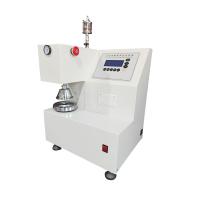
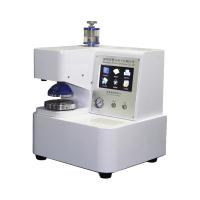
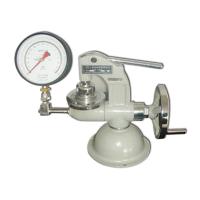
The Mullen Burst Tester is suitable for burst test of cardboard and corrugated board, as shown in Figure 1, the test principle is the hydraulic pressure increase method. Press the sample between the upper and lower chucks with a certain pressure, and the sample cannot slide. The motor drives the piston, and the piston pushes a suitable liquid (such as chemically pure glycerin, etc.) to apply pressure to the film at a constant speed, and the film protrudes to lift the sample until the sample breaks. The liquid delivery volume is (170±15)mL/min, and the pressure gauge indicates the maximum value of the applied pressure, that is, the burst resistance of the sample.

Figure 1 Mullen Burst Tester
1- Pressure gauge; 2- Compression mechanism; 3- Film; 4- Upper pressure ring; 5- Compression handle; 6- Motor; 7- Screw; 8- Piston
(2) 04BOM Burst Tester
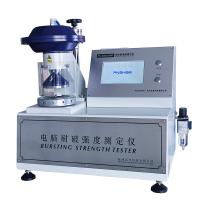
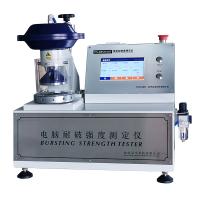
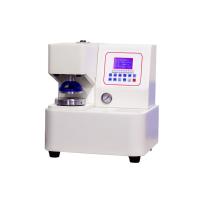
Structure and working principle Type 04BOM Burst Strength Tester is suitable for measuring the bursting strength of paper and cardboard, as shown in Figure 2-41. A rubber film is installed on the lower side of the hole of the lower pressure plate where the sample is placed, under which is a pressure chamber filled with glycerin, the pressure chamber
There is a piston inside, and the movement of the piston makes the film expand upwards and burst the sample. The pressure value is detected by the sensor installed in the pressure chamber, converted by the electronic circuit and displayed on the display. The fixation of the sample is achieved by air pressure. A cylinder and a piston are installed above the upper pressing plate, and the upper pressing plate is controlled by the air valve to press down or lift. The movement of the piston in the pressure chamber is driven by a pair of rack and pinion driven by the motor below it, and the movement of the rack forces the piston to pressurize or decompress. These movements are controlled by electronic circuits and completed automatically. The instrument is equipped with an output interface BCD, which can be connected to a printer or computer to print measurement results or perform data processing.

Figure 2 04BOM Burst Strength Tester
1-power switch;2-air source connector;3-piston;4-protective cover;5-upper platen;6-lower platen
②Main technical parameters
a. Maximum pressure: 2000kPa (PD type is used to measure paper).
b. Maximum pressure: 6000kPa ( JD type is used to measure cardboard).
c. Measurement accuracy: less than or equal to ±1%.
③ Calibration procedure
a. Check the pneumatic clamping force, PD type is 155kPa, JD type is 385kPa.
b. Turn on the power and preheat the instrument for 30 minutes.
c. Turn the three-position switch to the tracking position, and use the zero adjustment knob to adjust the display to zero.
d. Set the three-position switch to the inspection position, and observe the value on the display. If the displayed value is consistent with the "Check" value given on the instrument, and the deviation is less than or equal to ±1%, it means that the instrument is normal and can be tested.
e. If the deviation of the displayed value is greater than ±1%, put the three-position switch in the check position, and adjust the calibration potentiometer with a small screwdriver until the displayed value is consistent with the "Check" value.