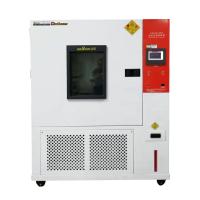
The weather resistance test is suitable for evaluating the adaptability of the transport package to various climatic conditions and the protection ability of the package for the contents. It includes high-low temperature test, spray test, water immersion test and low air pressure test.
(1) High-low temperature test
The high-low temperature test is suitable for evaluating the resistance of transport packages in extreme temperature environments of high or low temperature, as well as the protection of the packaging for the contents. The principle of the test is to place the sample in a laboratory (box) that can maintain the specified extreme temperature, and after a predetermined period of time, check whether the packing box and the contents are in good condition.
The extreme temperature value and test duration should generally be determined according to the specific requirements of the product. If there is no specific regulation, the high temperature of civilian product packages is 55°C, and the low temperature is -35°C; the high temperature of military product packages is 70°C, and the low temperature is -50°C. The temperature change in the test room (box) should be controlled within the range of ±3°C, and the test duration is 48h. The test time should start counting when the temperature in the test room (box) reaches the specified extreme temperature after the sample is put into the test room (box ) . After the test, check the appearance of the packing box and the contents, and observe whether there are cracks, cracks, whether the packing box can be opened freely, and whether the sealed package leaks due to extreme temperature environment.
(2) Spray test
The spray test, also known as the rain test, is suitable for evaluating the resistance of the transport package to the rain and the protection of the package for the contents. The principle of the test is to place the sample in the spray test environment, spray water at a predetermined time and speed under stable temperature conditions, and check whether the packing box and the contents are intact.
The test environment required for the spray test is the spray test device, which should be equipped with filters, water pumps, safety valves, measuring instruments, regulating valves, water nozzles, water storage tanks, and water pipes. Water temperature adjustment device, as shown in Figure 6-18. The area of the test environment should be 50% larger than the area of the bottom of the sample, so that the sample is within the spray area. The spraying device should meet the water spray volume of (100±20)L/(m2 h), the spray water should be sufficient and uniform, and the nozzle can be adjusted so that the distance between the nozzle and the sample can be kept 2m. Use a measuring device to calibrate the water spray rate, the maximum amount shall not exceed 120L/(m2 h), and the minimum amount shall not be less than 80L/(m2 h). , so that the water droplets do not spray directly on the sample.
Test according to the national standard GB4857.9 "Packaging and transportation package, spray test method". During the test , when the amount of water sprayed by the entire system reaches a stable level, place the sample. If there is no special requirement, the spraying water temperature and the temperature of the test environment should be between 5 and 30°C. The spraying time should be determined according to the waterproof performance of the package and the circulation environment. After the test, inspect the specimen for damage and any other changes.
(3 ) Water immersion test
The water immersion test is suitable for evaluating the water resistance of the transport package and the protection ability of the package for the contents. The principle of the test is to fully immerse the sample in water, keep it for a predetermined duration, take it out, drain and dry it according to the predetermined time and temperature, and check whether the packing box and the contents are intact.
The water immersion test of civilian products should be carried out in accordance with the national standard GB4857.12 "Packaging and transportation package water immersion test method". Before the test, each part of the sample should be numbered according to GB 4857.1, and a condition should be selected according to GB4857.2 to adjust the temperature and humidity of the sample. The specific test method is to sink the sample into the water, and the top of the sample should sink 100mm below the water surface. The test water temperature is selected within the range of 5-40°C, and the change of water temperature during the immersion process should be controlled within the range of ±2°C. The lowering speed of the sample The time for the sample to be kept below the water surface can be selected from 5min, 15min, 30min or 1h, 2h, 4h. After reaching the specified time, lift the sample out of the water at a speed of 5mm/s. The specimen is then placed on the grating in the working position, with all sides exposed, and the specimen is allowed to drain and dry. Choose one of the exposure time from 4h, 8h, 16h, 24h, 48h, 72h or 1 week, 2 weeks, 3 weeks, 4 weeks. After the test, inspect the specimens for any obvious damage caused by immersion, draining, drying and any other changes.
The water immersion test of the transport package of military products should be carried out with reference to the national military standard "Environmental test methods for military equipment, immersion test". The water temperature of the test should be controlled at 8-28°C, and the change of water temperature should be controlled within the range of ±3°C. Before the test, the sample should be pretreated in an environment higher than the water temperature of 27 °C. The depth of water immersion is 1m from the top surface of the sample to the water surface, or according to relevant standards or technical documents. The soaking time is (120±5)min.
For sealed packages, in the water immersion test, the pressure difference between the inside and outside of the package due to the temperature difference and water pressure may cause the package to lose its airtightness and cause water to enter, and some non-water-resistant adhesives, sealing tapes and other components may deteriorate and fail. After the test, check the water ingress of the package, the position and degree of water ingress, the damage to the contents after ingress of water, the deterioration and failure of product parts after immersion in water, and the swelling and cracking of the packaging box after immersion in water.
(4) Low air pressure test
Low air pressure can cause the package to lose its seal, resulting in air leaks, liquid leaks, and even crushed containers. Under high-altitude conditions, the combination of low air pressure and low temperature may lead to changes in the physical and chemical properties of some packaging materials, making the materials brittle, and the packaging containers and their contents are prone to damage under the action of certain mechanical forces.
The low air pressure test is suitable for evaluating the ability of the transport package to withstand the influence of low air pressure in a non-pressurized cabin aircraft with a flight altitude of no more than 3500m and in a pressurized cabin aircraft with a flight altitude of more than 3500m, and the ability of the package to protect the contents . The principle of the test is to place the sample in a low-pressure test box (chamber) with an air pressure equivalent to the atmospheric pressure at an altitude of 3500m for a predetermined time, then restore the test box (room) to normal pressure, and check the damage of the package and the contents . If necessary, the temperature of the Test Chamber (chamber) can be controlled during the test to the air temperature it has at the same height. Choose one of the air pressure holding time within 2h, 4h, 8h, and 16h. For different altitudes, the relationship between standard atmospheric pressure and altitude is shown in Table 6-17. When carrying out the low pressure test on the transport package in the non-pressurized cabin aircraft with a flight altitude exceeding 3500m, you can refer to the test parameter values given in Table 6-17.

Table 6-17 Relationship between low pressure, temperature and altitude
The test is carried out according to the national standard GB4857.13 "Low pressure test method for packaging and transportation packages". This test method is also applicable to packages for rail transport or road transport at high altitude and low air pressure. The specific test method is to place the sample in a low-pressure Test Chamber (chamber), reduce the air pressure to (65.0±0.5) kPa at a rate not exceeding 15kPa/min, maintain the air pressure within a predetermined time, and then continue to When the pressurization rate exceeds 15kPa/min, dry air that meets the temperature of the Test Chamber (chamber) is filled to restore the air pressure in the Test Chamber (chamber) to its original state. If it is necessary to evaluate the influence of the two test parameters of air pressure and temperature on the transport package, the temperature in the Test Chamber (chamber ) should be kept at (-8±1)°C during the test . After the test, check the packaging and the changes in the contents to determine whether they are damaged.
For the low-pressure test of military product transport packages, the test parameter values are relatively high, and the air pressure in the test box (chamber) should be controlled at the corresponding atmospheric pressure (about 57kPa) when the flight altitude is 4500m. The duration of the test is 1h, and the rate of depressurization and pressurization is not greater than 10kPa/min.