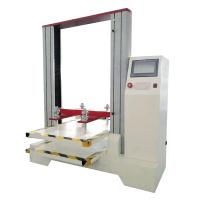
该试验适用于评定大型运输包装件在堆码时顶面、侧面和端面的承载能力以及包装对内装物的保护能力。堆码试验分为顶面承载试验和侧、端面的承载试验。
(1)顶面承载试验
该试验模拟大型运输包装件上堆码小型包装件时顶面上受力的情况。试验原理是在包装件的顶面上施加均匀分布的载荷,按预定的载荷和试验持续时间承载。载荷的大小按500kg/m2确定,载荷误差应控制在预定值的2%之内。加载方式有以下两种:
①用木板钉成与包装件尺寸相同的围框,在里面均匀堆放沙石,如图6-22(a)所示;
②用底面尺寸是25cm×25cm的方形箱盒,内装沙石或其他重物,每0.1m2放置一个方形箱盒,如图6-22(b)所示。

图6-22顶面承载试验原理
1-测量标尺;2-围框;3-重物
以上两种情况可According to实际情况选用。对于体积较大的包装件,也可According to情况将组装好的顶盖单独放于支承台架上进行试验,如图6-23所示,顶盖与支承台的结合形式应与实际包装箱的顶盖与箱体的结合形式一致。

图6-23 顶盖与支承台相结合的顶面承载方式
1-垫木;2-侧面上框架;3-顶盖;4-顶盖横梁;5-梁撑
(2)侧、端面承载试验
该试验模拟在大型运输包装件顶面上放置加载平板(如平托盘)之后,再堆放其他包装件的堆码情况,此时包装件的侧面和端面是主要受力部位。试验原理是在包装件顶面放置有足够刚度的加载平板,将重物放于加载平板上,载荷大小和加载时间按预定的要求。加载平板的尺寸应大于包装件顶面各边10cm。重物应均匀摆放。载荷大小应参考表6-19所给出的侧、端面承载试验时顶面载荷量,按包装件的质量和顶面面积确定,载荷误差应不大于预定值的2%。一般情况下,堆码时间选取24h。对于需要采用远洋运输的包装件,其堆码时间选取一周。

表6-19侧、端面承载试验时顶面载荷量
(3)挠度、凹凸度测量
Before loading and after unloading, the deflection of the upper frame, the diagonal deformation of the end face and the side, the concavity of the top surface of the package, and the concavity and convexity of the side of the package should be measured. Check the performance of the parts, and check the damage of the contents if necessary.
① Measure the deflection of the upper frame. Nail nails at the two ends of the side surface about 3cm away from the top surface and the end surface, and connect the string between the nails that can maintain a tight state during the test, and mark the package along the position of the string. After the test, measure the maximum distance between the string and the marking on the package as the deflection value.
②Measure the diagonal deformation of the end face and side. The measurement method is the same as the method for measuring the deformation of each diagonal line after the previous drop test.
③ When the top surface is loaded, measure the concavity of the top surface of the package. Select the central part of the top surface and several other parts expected to be larger in deformation as the measurement points. When stacking sand and gravel, a ruler perpendicular to the top surface can be set at the measurement point for measurement. When heavy objects such as boxes/boxes are stacked, a ruler can be used to measure across the top surface along the width of the packaging box.
④Measure the unevenness of the side of the package. As shown in Figure 6-24, use a string with a weight attached to it and a ruler to measure the vertical distance between the most convex (or most concave) side of the package and the bottom slide.

Figure 6-24 Measurement of unevenness on the side of the package