(1) Purpose and Definition
Gloss in print has long been sought after (matte prints are a rare exception). There are many printed matters that require varnishing, plastic coating, lamination , etc. , the purpose of which is to improve the appearance of printed matters. Of course, there is another layer of material on the printed matter, which also has the function of protection.
Once a layer of transparent material is added to a dull and dull printed matter, its effect will be greatly improved. So the effect of a print is closely related to its gloss.
Since the printed matter is coated with a transparent substance such as a layer of oil film, its color brilliance will be greatly improved (mainly due to the principle of optics), and it looks more energetic. Therefore, improving the inherent gloss of the ink itself has become an ink manufacturer. The goal.
The luster of an object seems to be a very common concept, but in fact it is a relatively complicated phenomenon, which is related to physical psychology. The so-called gloss of the ink actually refers to the ability of the printed sample of the ink (scratch sample not available) to reflect in one direction when it is irradiated by light. Although the evaluation of gloss can be compared by eye observation, the difference between them cannot be expressed numerically. This can be done with instruments.
At present, most of my country's ink industry uses a reflective gloss (degree) meter to measure the gloss of ink. This instrument is equipped with a fixed light source to shoot at the surface of the oil halo printing sample at a predetermined incident angle, and then uses the photoelectric principle to measure the light reflected from the surface of the printing sample, and compares it with the predetermined incident angle under the same conditions. Compared with the amount of light reflected by the standard plate surface.
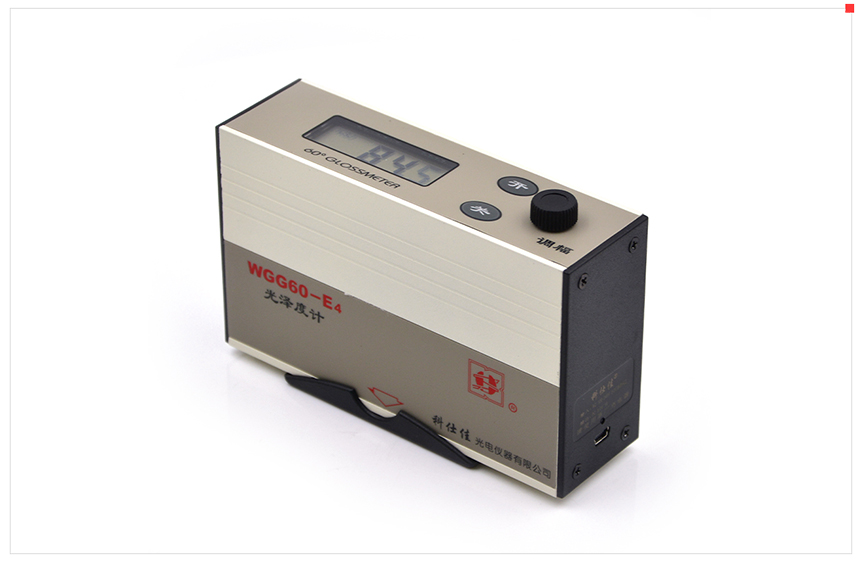
Since the ratio of the amount of light reflected from the surface of the ink print to the amount of light reflected from the surface of the standard plate is often expressed as a percentage, the gloss of the ink is also a percentage value.
(2) Equipment and materials
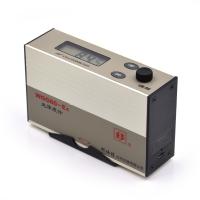
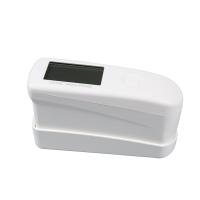
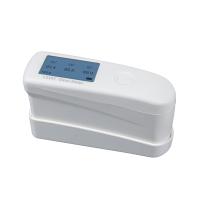
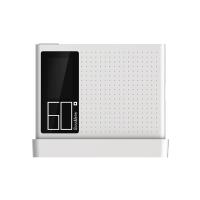
1. Utensils. Reflectance Gloss Meter.
2. Materials. Ink proofs (solid prints).
(3) Method
Gloss (degree) meter generally has three main components, namely gloss measuring head, galvanometer (mostly adopt floating mirror light point type ) and standard blackboard.
The simple structure of the Koyo measuring head can be seen in the figure. In the figure, 1 is the light source. The light passes through the lens 2 into parallel light, and shoots to the tested sample 5 at a certain incident angle α. The reflected light that is at right angles to the light emitted by the person) is projected on the photocell 4 through another lens 2 and the diaphragm 3, so that the photoelectric cell generates a photocurrent proportional to the amount of reflected light. The incident angle of the light source varies with the instrument, and the angle of the variable gloss measuring head can be from 15° to 85°. However, most of the measuring heads for measuring ink gloss in my country are 45° at present. For inks printed on metal surfaces with high gloss, you can choose the one with a smaller incident angle of the light source, because the smaller the incident angle of the light source, the more sensitively the high gloss can be distinguished. On the contrary, you can choose a measuring head with a larger incident angle of the light source.

The structure of the measuring head of the gloss meter
The galvanometer is a kind of galvanometer used to detect the photocurrent generated by the photoelectric tube in the gloss measuring head. Generally, the light spot reflection type is more, and the detected current is passed through the optical reflection device (floating mirror) ) is reflected on a scale with a scale of 0-100 percent.
A black standard is used as a comparison standard for gloss measurements and is usually a black polished flat glass plate. Its gloss standard is set at 100%.
The operation methods of such instruments are similar, and the operation steps can be roughly summarized as follows:
1. Turn on the power, turn on the switch, and let go of the protective device of the galvanometer pointer or floating mirror.
2. Adjust the pointer of the galvanometer or the light point of the floating mirror to the zero position with the zero point regulator of the instrument.
3. Adjust the induction controller to the "0" point in the counterclockwise direction, so as not to cause overload after connecting the gloss measuring head and damage the instrument.
4. Connect the gloss measuring head.
5. Place the gloss measuring head on the standard blackboard, and adjust the induction controller so that the pointer of the current gauge or the hairline on the light spot of the floating mirror is at 100 on the percentage scale (that is, the gloss of the standard blackboard is 100) .
6. Move the gloss measuring head to the ink print, at this time the position pointed by the pointer or floating mirror light spot is the gloss number of the ink print.
(4) Matters needing attention.
1. Preparation of ink printing samples - Generally, a printability Tester can be used to print, but the thickness and smoothness of the ink layer are the key to the success of the gloss measurement. Due to the unevenness and unevenness of the print, it is not uncommon to see different gloss data on the same print.
2. The paper used for printing samples has a great influence on the gloss data. Different papers will get different data. The paper used to measure ink gloss is generally coated paper with a smooth surface.
3. The drying degree of the ink printing sample has an influence on the gloss. Generally speaking, the gloss data of the ink printing sample that is not effective is often high.
4 When using the gloss measuring head to measure the gloss, it is necessary to pay attention not to let the external light leak into the measuring head, so as not to cause inaccurate data.
5. Positive and reflective gloss will not be affected by the lightness of the color, that is to say, the lightness and darkness of the color have nothing to do with the gloss.
6. At present, most of the measuring heads for measuring ink gloss in our country use angles of 45°. Some countries in the world (such as the United States, Japan, etc.) use a 60° angle.