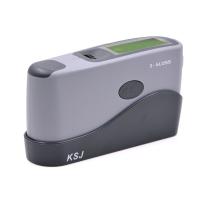
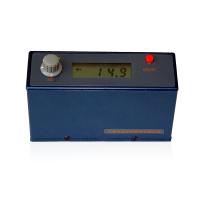
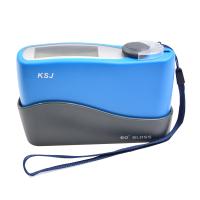
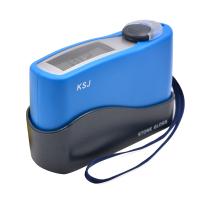
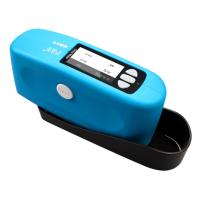
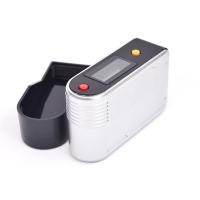
The appearance of the coating film can be divided into two categories: visual inspection method and optical measurement method. Visual inspection is to directly observe whether there are defects on the surface of the coating film, such as particles, bubbles, pinholes, pitting, spots, cracks, scratches, etc. According to (GB 4054-83, coating appearance grades are divided into 4 categories:

The optical measurement method is to use various optical instruments to measure the brightness, flatness, color and color uniformity of the coating film.
Gloss (GB/T l743-89)
The light is projected on the surface of the coating film at a certain incident angle, and the amount of light reflected at the corresponding angle is the gloss measurement formula. See Figure 8-5
Under a certain incident angle, the surface of the coating film is rough, the flatness is poor, the scattered light is more, the reflected light is less, and the gloss is low. The coating gloss measured by 60% gloss meter is classified as follows:
| high gloss | ≥70% |
| semi gloss or medium gloss | 30%-70% |
| eggshell light | 6%-30% |
| flat light | 2%-6% |
| dull | ≤2% |
As the incident angle increases, the intensity of reflected light increases. According to ASTM D523, for high-gloss coatings exceeding 70%, it is advisable to use a 20° incident angle light translator for measurement. Conversely, for low-gloss coating films below 30%, an 85° gloss meter should be used for measurement.
According to the provisions of IS02813, the 60 gloss meter measures the photoselectivity range of 30%-70%. For high gloss, the photoselectivity data of 20° and 60° should be given at the same time. At this time, for ease of use, a multi-angle (or variable-angle) Glossmeter can also be used to measure the gloss under different incident light.
For flash paint, a multi-angle Spectrophotometer can be used to test the flash effect. For example, the incident light of MA58 (25°, 45°, 75°) and MA68 (15°, 25°, 45°, 75°, 110°) of the American X-Rite series remains unchanged at an angle of 45°. Detect the reflected light intensity at different observation angles [see Figure 8-6a]. When the aluminum powder is arranged in parallel in the coating film, the specular reflection has the maximum reflected light intensity, and the larger the angle away from the specular reflection, the stronger the scattered light and the weaker the received reflected light [see Figure 8-6b]. In the spectrum of the light intensity signal of the photocell and the observation angle, if the peak is higher and the peak width is narrower, when observed from different angles, the light and shade changes of the reflected light are stronger, the flashing effect of the flash paint is stronger, and the flashing effect is better.