(1) Purpose and Definition
The lightfastness of the ink is determined because many printed products (such as posters, slogans, advertising tubes, etc.) are exposed to sunlight for a long time. If the ink used is not lightfast, it will cause discoloration and fading of the printed matter, and in severe cases, the forehead color can even be completely faded. As for the printed matter that is not directly exposed to sunlight (all kinds of packaged and printed plays, books, light industrial supplies, etc.), in fact, it is also indirectly affected by light. Therefore, the determination of the light fastness of ink is an important application item.
The color of an object is given by light, but light also destroys the color.
The light fastness of the ink mainly depends on the light fastness of the pigment. Generally speaking, the higher the pigment content per unit volume, the better the light resistance of the ink (see Figure 27~12). The irradiation of light will cause chemical changes and physical changes in the pigments. The former can cause the pigments to undergo (light) chemical reactions, and the latter can cause the pigments to undergo physical (crystalline) changes. These factors will cause the pigments to darken, lighten, and even Fade completely.

Figure 27-12 The relationship between the pigment content in the ink and its light resistance
Of course, the quality of the binder may also affect the light resistance of the pigment more or less.
Simply put, the determination of the light resistance of the ink is to measure the resistance to light of the linking material (oil plastic) after pigmentation.
(2) Equipment and materials
1. Utensils
(1) Foolish knife in a minor tune.
(2) Squeegee.
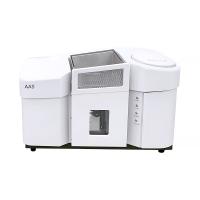
(3 ) FadeOmeter (commonly known as exposure meter).
(4) Light fastness blue (commonly known as wool ) standard (GB730-65).
(5) Color fastness fading sample card (GB250-64 ) .
2. Material: scraping paper
(3) Method
Scratch a sample according to the determination of color, but do not leave a part of the thick ink layer, and let it dry at room temperature.
Cover half of the sample and the "Blue Standard for Light Fastness" (eight types) with black cardboard (lined with white writing paper), and then put them together on the fader for exposure. When the degree of fading of the blue mark of level 7 is equivalent to level 3 of the "color fastness fading sample card", it is the end point of exposure, and the exposure is stopped. Take the sample and the eight blue standards out of the exposure meter, put them in a dark place, and grade them after half an hour.
Comparing the sample with the blue standard, the discoloration or fading of the sample is equivalent to that of the blue standard of that level, then the light fastness grade of the sample oil is equal to the grade of the blue standard.
(4) Matters needing attention
1. The drying degree of the ink scraping sample has an influence on the test result. For this reason, if necessary, an appropriate amount of desiccant can be added to the ink.
2. The quality of the paper will affect the light fastness of the ink. For this reason, the paper should be neutral wood-free paper that does not change color and yellow under the light source, and does not contain photobleach. If a printing suitability Tester is used to make printing samples, the quality requirements for coated paper are also relatively strict.
3. Figure 27-12 has pointed out that within a unit volume: the higher the pigment content (of course, there is a critical point), the better the light resistance of the ink (and there is a limit). Therefore, the thickness of the ink layer of the scraping or printing sample will definitely affect Noon oil reclamation of light.
If you want to standardize the inspection, it is better to use a printed sample (with a printability Tester) for the measurement. The ink layer thickness of the proof is 1±0.2 microns.
4. The temperature and humidity conditions during the measurement are also under certain control.
5. If there is no black cardboard, other materials such as carbon paper can also be used as the shading material.
6. Obviously, choosing different light sources will result in different light fastness results. As far as the above is concerned, more people use xenon lamps, and the color temperature of xenon lamps is specified as 5500-5600°K.
Sunlight exposures can be used when no equipment is available.
7. The end point of exposure can also be covered by black thick board in steps, which is helpful to understand the whole process of the fading of the ink under test, and can also be used to see the fading of the ink under the condition of no exposure time, so it can be used as a rating time reference.
The so-called step-by-step cover is to expose the secondary sample (or printed sample) to the fading instrument, cover a part (such as 1 cm) with black thick board paper at a certain period of time (such as 20 hours), and then cover it with a certain period of time (such as 20 hours). ) and then cover a part, and so on, in this way, you can get the graded results of exposure with different exposure times.
Exposure can also be carried out according to the method shown in Figure 27-13: the ink scraping sample and the blue mark

Schematic diagram of the national 27-13 adjacent comparison measurement method
Divide it into five equal parts and cover it in stages. Parts 1 and 4 in the circle are always covered with black thick cardboard during the exposure process; when the level 4 blue standard has just faded to the degree of fading equivalent to the level of the level 4 faded sample card, then cover part 2; continue to expose When the degree of fading to the level 6 blue standard is equal to the level 4 fading sample card, then cover the Jialu part; finally, when the degree of fading to the level 7 blue standard is equivalent to the level 3 fading sample card, stop the exposure. After half an hour in the future, the rating can be carried out.
This method of exposure allows each shaded portion to be compared to the adjacent unexposed portion.
8. Blue standard for daylight fastness: This is composed of eight blue wool fabrics with different lightfastness, and each blue wool fabric represents a lightfastness grade, and the scale is from 1 to 8. Nomenclature, these eight levels of standards, when exposed to a certain light source at the same time, there will be eight different fading conditions, the first level of fading is the most serious, indicating the worst light, the second level is the second, ... the eighth level is not easy to fade , indicating better light fastness.
These eight kinds of blue wool fabrics are dyed on wool fabrics by eight kinds of blue dyes with different fastness respectively at specified concentrations. The names and specifications of these eight kinds of dyes are shown in Table 27-6.
Who is the more common rating standard in this set of blue labels. Since the exposure time, different light sources or changes in the light source itself during over-exposure will affect the results of the blue standard, the color fastness fading sample card should be used for determination. Ratings require extensive experience.

9. Color fastness fading sample card: also called gray fading standard, a gray standard sample composed of five neutral gray standard samples of different shades, each gray standard sample represents a fading level. The reflectance of the darkest gray standard sample is specified as 12 ± 1%; the depth of the other four neutral grays is gradually shallower according to the specified geometric level.
There are specific regulations on the color difference between the five gray standard samples. The color difference is measured by a Spectrophotometer and calculated by using the 3-18 formula 1, namely the ANLAB color difference formula, and they all conform to the regulations in Table 27-7.

When applying this set of fading sample cards, put the original sample and the sample (in the light fastness test, the original sample that has been exposed) on the sample card, and compare them with each gray standard. When the degree of fading of the sample is equivalent to the gray standard, the degree of fading is evaluated according to the grade of the gray standard sample. If it is between the two grades, it can be rated as Zhongmin grade and written as 3-4 grades, etc. Its meaning means that it is worse than Lu level, like level 4.
In fact, the color change caused by fading includes three aspects of color depth, light and shade, and color.
For comparison and observation, it should be carried out under the light of the northern half pass. If other light sources are used, the total illuminance should not be less than 540 lux. The angle of light projected onto the sample card is about 4.5 degrees, and the line of sight and the plane of the sample card should be close to vertical.
10. A relatively simple exposure method is to put the sample together with the eight kinds of light fastness blue standards in the fading instrument for several hours (such as 20 or 40 hours, etc.), and then take it out to observe the fading of the sample and that If a standard is close, the light fastness of the sample is the standard level.