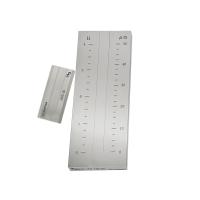
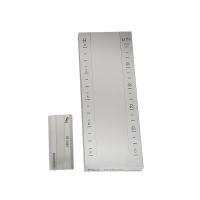
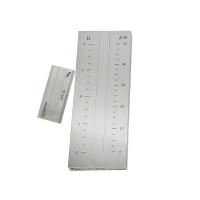
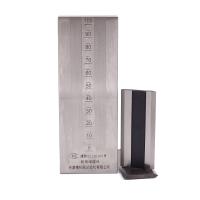
The scraper Fineness Meter is used to detect the fineness of pigments, coatings, inks, etc. The scraper Fineness Meter is micron, and the corresponding relationship between Mill and Hegman is as follows:
1 mil = 25.4 um, 1 mil = 0.001 inch, 1 um = 0.001 mm
0 Hegman = 4 mil, 100 um
4 Hegman = 2 mil, 50 um
8 Hegman = 0 mil, 0 um
* Hegman is usually represented by a capital "H".

Hegman gauges are used to place a paint sample deep in the gauge and to pull the paint down with a flat edge along the groove. Grinding gauges are sold with flat "pull bars" specially machined for this purpose. The grooves are filled with paint, and the position where the appearance of the coating appears regular, pronounced "pepper" marks the coarser abrasive dispersed particles. This is the point at which oversized particles begin to appear at a high density and determines the grade of the material. Readings are taken from the scale marked next to the groove, in dimensionless "Hegman Units" (or National Standard Units; NS) and/or mils or microns. Hegman units are defined according to the size scale of the inversion, as follows
| Hegman Units | Mils | Microns |
| 0 | 4 | 101.6 |
| 1 | 3.5 | 88.9 |
| 2 | 3 | 76.2 |
| 3 | 2.5 | 63.5 |
| 4 | 2 | 50.8 |
| 5 | 1.5 | 38.1 |
| 6 | 1 | 25.4 |
| 7 | 0.5 | 12.7 |
| 8 | 0 | 0 |
The paint industry also occasionally uses the lesser-used scale North (or PCU). Like the Hegman scale, this is also inverted compared to the micron value:
| Microns | North units |
| 0 | 100 |
| 10 | 90 |
| 20 | 80 |
| 30 | 70 |
| 40 | 60 |
| 50 | 50 |
| 60 | 40 |
| 70 | 30 |
| 80 | 20 |
| 90 | 10 |
| 100 | 0 |