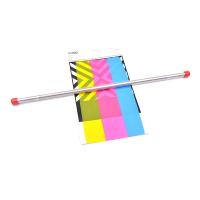
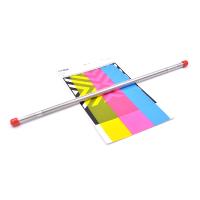
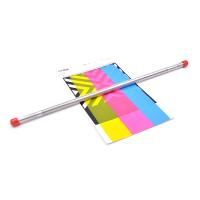
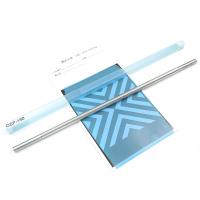
In this experiment, a transparent antistatic film was prepared by applying an external force to the wire-wound rod while pulling it at a constant speed. A sketch of the wiper film is shown in Figure 2-3. The specific steps are first soaking the PET film with deionized water, then drying it with acetone to prepare a clean PET film. Then fix the PET on the Heating Plate, absorb the carbon nanotube solution with a straw, draw a uniform horizontal line of carbon nanotube ink on the top of the PET from left to right, and pull the scraping rod from top to bottom with a uniform force. Or dry at room temperature for about 2 minutes.

We choose two methods for the post-treatment of the film, one is called water-washed film, the scraped film is soaked in distilled water for about 10-20 minutes, dried in a Forced Air Drying Oven at 80°C, and washed with distilled water for 3 After drying, soaking in distilled water for 30 minutes and drying, this method is called water treatment, and the prepared film is called water-treated antistatic film (waterwashedTAFs). The second is to soak the scraped film in distilled water for about 10-20 minutes, dry it in a Forced Air Drying Oven at 80°C, wash it with distilled water 3 times, dry it, soak it in concentrated nitric acid for 30 minutes, wash and dry it, It is called acid treatment, and the prepared antistatic film is called acid-treated antistatic film (acid-treated TAFs). Test the surface resistance of the film separately to choose a better method.
In order to prepare an antistatic film with relatively low surface resistance, high adhesion and high transparency, we first analyzed the effects of various additives on the surface resistance and adhesion of the film in the process of preparing the antistatic film. In solution, add dispersant (SDBS), tackifier (TX-100) and binder (WPU), which are used to disperse carbon nanotubes, prevent dewetting and improve adhesion, dispersant, tackifier And the binder can not only affect whether the film can be scraped out, but also affect the surface resistance . The ratio should be optimized to prepare an antistatic film with excellent performance. SDBS is a suitable proportion of dispersed carbon nanotubes, and the influence of SDBS content change on film properties is no longer discussed. Only change the content of WPU and TX-100 to prepare the solution, scrape out the film and prepare the film through water treatment and acid treatment, respectively test the surface resistance and adhesion of the film, and compare the surface resistance and adhesion After determining the appropriate ratio, optimize the ratio of the solution for preparing the film.
Excerpt from " Preparation and Properties of Carbon Nanotube Antistatic "
Author: Yang Haijie Tianjin University of Technology