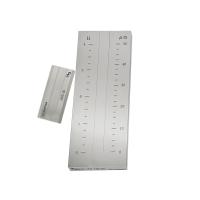
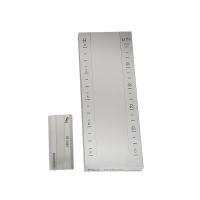
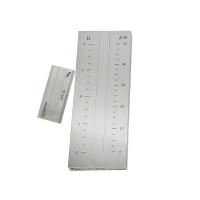
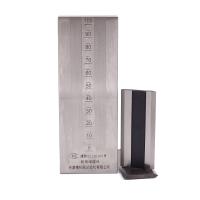
The agglomeration degree (commonly known as fineness) of noble metal paste refers to the size of solid aggregates in the paste, and its thickness directly affects the printing performance and sintering characteristics of the paste. Fineness is an important index that needs to be detected and controlled in the production and use of slurry, and the measurement of fineness is of great significance to the quality control of slurry . According to literature reports, standard fineness gauges are used to test the fineness of slurry; otherwise, fineness scales are used to test the fineness of slurry. With the development of the electronics industry, precious metal pastes have been widely used in communications, automobiles, and home appliances. At present, domestic manufacturers and users of precious metal pastes do not have a unified standard for the fineness detection of pastes. In order to adapt to the development of paste and the needs of industrialized production, to ensure product quality and unify product standards, the author used a scraper Fineness Meter to measure the fineness of silver series paste, silver palladium series paste, silver platinum paste, and Test conditions for comparison and discussion
Experimental sample
Fully stir the samples of silver series paste, silver palladium series paste and silver platinum paste evenly, and take 5 balanced samples for each sample, 2g for each sample.
Methods and Instruments
The fineness of the precious metal paste was measured with a QXD-50 scraper Fineness Meter. The operation process is to place the sample on the fineness gauge, scrape the scraper from top to bottom, and determine the particle size according to the position where the longitudinal stripes appear in the groove.
Test steps:
① Wash carefully with chloroform and dry the scraper fineness gauge;
②Put the prepared sample on the top of the Fineness Meter;
③ Use both hands to hold the scraper, place it on the upper end of the scraper (at the edge of the sample), and pull the scraper from the deep part of the groove to the shallow part at a suitable speed on the surface of the scraper and the fineness gauge, so that The sample fills the groove without leaving excess slurry on the plate;
④After the scraper is pulled, hold the fineness gauge horizontally and tilt it immediately (not more than 5s), so that the line of sight and the groove plane form an angle of 15° to 30° and observe the light to find out the position where two longitudinal stripes appear in the groove. and read and record;
⑤Ambient temperature 15~35℃, relative humidity 25%~85%