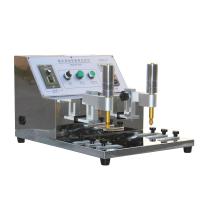
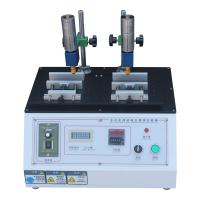
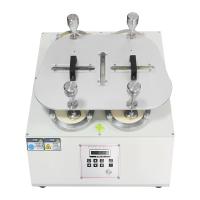
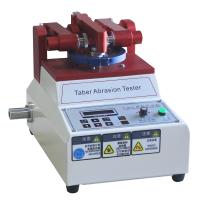
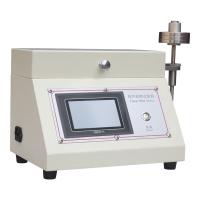
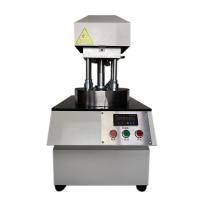
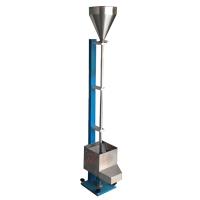
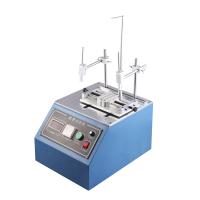
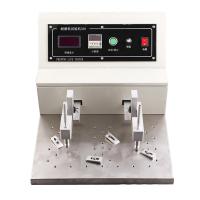
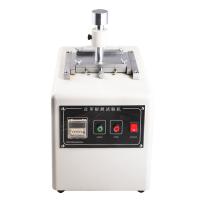
Abrasion testing is a standard procedure used in manufacturing and industry to study a product's resistance to damage and wear caused by abrasion. Laboratories use various methods for wear testing, but there are some basic methods that are labeled as international standards. These tests are given the ASTM designation, which indicates that the methods were developed by ASTM International, an international organization for manufacturing standards. Abrasion testing is used on a variety of manufactured goods to test the abrasion resistance of materials such as paints, adhesives, cloth and metals.
Two common wear testing methods are the pin test and the dry sand/rubber wheel device test. For the pin test, a rotating pin follows a fixed wear path to create wear on the surface. The dry sand/rubber wheel device test uses a rotating rubber wheel that is held at a distance from the sample piece. Dry sand is then introduced into the gap between the grinding wheel and the sample, flowing in the same direction as the wheel motion. The dry sand used was of uniform particle size and composition to ensure consistent abrasive quality during testing.
An example of a pin test is the Standard Test Method for Abrasion Resistance of Coated Fabrics, or ASTM D3389, Abrasion Test Procedure, for measuring the abrasion resistance of plastic or rubber-coated cloth. This test measures the loss of mass from fabric coating or abrasion as a result of interaction with a rotating pin. The weight and thickness of the material are carefully measured prior to testing and compared to the resulting measurements after the testing procedure is complete.
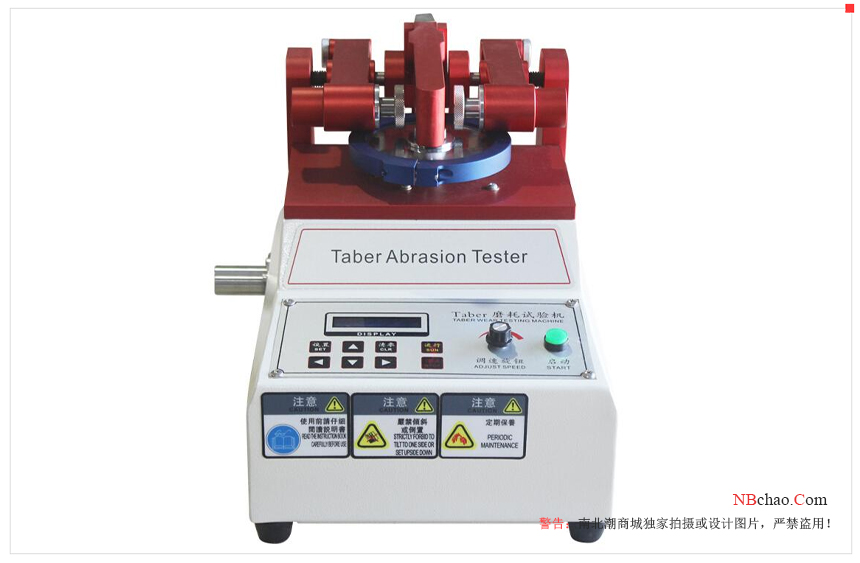
ASTM G132 is another lead test method called the two-lead method, which uses two leads perpendicular to the test product and a control product with a known resistance factor. For this test, sample and control materials are weighed prior to testing. The pins travel along a continuous path, creating wear on the surface of the material. After the test is complete, the two pieces are removed from the abrasion Tester and reweighed; the resulting weight loss is measured using a formula that includes safeguards against changes in the abrasive properties of the pin.
Standard Test Method for Measuring Abrasion Using Dry Sand/Rubber Wheel Apparatus, also known as the ASTM G65 test, is an abrasion test method for measuring mass or volume loss from dry sand abrasion. The test is performed by introducing a stream of sand into the space between the wear-resistant sample under test and the rotating rubber wheel. The test lab technician then measures the resulting mass or volume loss in the sample product. This test is commonly used to test the abrasion resistance of hard surface coatings such as paint, and to test solid products including plastics, metals or ceramics.