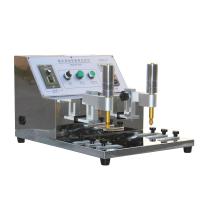
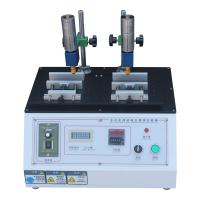
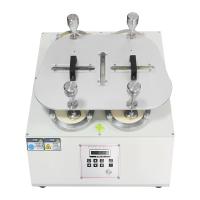
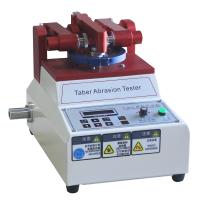
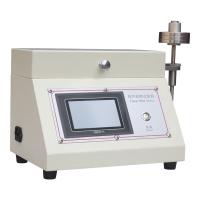
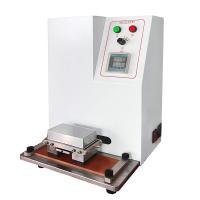
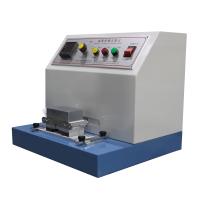
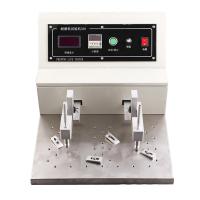
The NBS Abrasion Tester, also known as the NBS Abrasion Tester, is a professionally designed piece of equipment specifically designed to determine the abrasion resistance of vulcanized rubber and other similar materials commonly used in shoe heels and soles. This device is especially useful for materials thicker than 2.5 mm.
It is generally accepted that when comparing different types of rubber materials, service performance may not be directly related to the results of predictive tests. The test method shall not be used to measure the abrasion resistance of materials whose composition differs significantly from that of a reference compound standard.
For example, when comparing a polyurethane composition to a reference compound standard, the results can be misleading.
Generally, there are two types of wear. These are slides and bumps. When the adjacent surface crosses the rubber surface, it is sliding wear. Impact wear, on the other hand, is characterized by sand particles striking the surface as the rubber wears away. In actual use, most wear is a combination of both types of wear.
Localized or restricted friction creates high levels of energy as it slides over rubber. Wear and tear occurs when the rubber cannot withstand this force.
Particle impact occurs in a variety of applications such as rebound panels, blast hoses and chutes. Elastomers can easily yield and then dissipate the stress from particle impact. In the sandblasting test, there will be a 90 degree impact angle. Elastic and soft rubber offers greater wear resistance than cast iron or steel.
However, you can't just use any type of elastomer. However, under the exact same conditions, a hard tire tread will wear out faster than a softer type of elastomer. The angle of particle impact has a substantial effect on the type of material to be used. At angles below 90 degrees, the advantage of elastomers over hard metals decreases and eventually disappears.
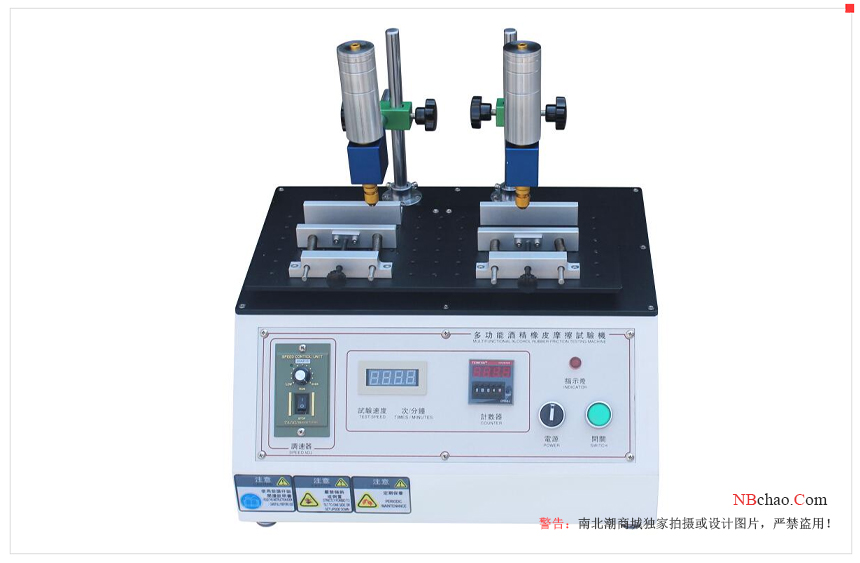
Correlating wear testing performed in the laboratory to end-use applications can be difficult. Measurement of properties will aid in material selection. However, comparisons to rates in real service are not recommended as it can be thousands of times larger in terms of temperature and speed.
There are at least 25 laboratory wear testing devices available. This clearly shows that this kind of testing is not easily correlated with service performance. In the rubber industry, the most widely accepted test equipment is the National Bureau of Standards (NBS) Abrader. It is a sling scraper. NBS abrasive machines operate at a constant speed and use the specified abrasive grit under a fixed load.
It does not show how a particular compound will perform under widely fluctuating conditions. It also doesn't give any indication of the material's cut resistance, flat spots or lumps.
Abrasion resistance test results for urethane vulcanizate, using two laboratory tests, please note that the two tests yield different values. However, there is an explanation for the difference in urethane sulfide performance. The NBS test is a simulation of very harsh conditions of use. In this particular case, the hardest of volcanoes holds up well.
The Taber test, on the other hand, is a much less punitive type of test. Softer compounds exhibit better performance than harder materials because they have more elasticity and "give" under load.
Sliding wear resistance increases with increasing NBS test hardness. 75A cemented carbide sulfide has an unusually high NBS index. This may be due to the plasticizer used in the compound lubricating the wheel.
As the hardness of the polyurethane increases, the NBS value of the non-plasticized compound increases accordingly.
Undoubtedly, it is quite difficult to obtain meaningful values from laboratory wear tests. However, despite this, polyurethane is considered to have excellent sliding wear resistance. It performs well in many applications where wear is considered an issue. In tests, polyurethane has consistently outstripped traditional plastic and rubber materials, often by as much as 8 to 1.
As mentioned earlier, the NBS Abrasion Tester is a machine used to test the abrasion resistance level of vulcanized rubber and other rubber-like compounds. The system generally complies with ASTM D1630 and ASTM D394 standards. Common applications include shoe heels and soles. Typical models are equipped with intelligent systems for power failure recovery. It is measured by volumetric sample loss when exposed to the motion of a normalized abrasive media attached to a rotating cylinder.
Frequently Asked Questions About NBS Abrasion Testers
Below are frequently asked questions and their answers about the NBS Abrasion Tester. Hope you find answers to some of the questions on your mind.
Q: Which applications are not suitable for NBS wear testing?
A: Not all rubber materials can be tested with the NBS Abrasion Tester. First, the machine is not suitable for thin polyurethane materials. When a material is exposed to the higher wear levels of the NBS Tester, it takes only a few short laps to wear away. A known benchmark for materials suitable for use with an NBS abrasion Tester is the hardness of the vulcanized rubber.
Q: How does the NBS Tester perform compared to the DIN abrasion Tester?
A: The NBS testing machine is the ideal choice for testing thicker materials. A more abrasive plate attached to the rotating drum is used to expose the rubber material to more intense rotation. Therefore, the wear evaluation is faster compared to the test results using the DIN wear Tester.
Q: What materials are typically tested with an NBS abrasion Tester?
Answer: A common test material for the NBS abrasion test method is vulcanized rubber, which is a fixture in the footwear industry. Specifically, these materials are used in heels and soles, among other footwear.
Q: What are the requirements for the material used as a sample for the NBS abrasion Tester?
A: Three reference compounds and one new reference compound are required for testing. The original reference compound standard needs to be 8 inches long by 1 inch wide. The lab cuts the material to standard sizes specifically for rubber wear testing.
The standard reference compound should measure 1 x 1 x 0.25 inches. The specimen needs to be of this size to fit in the arm slot of the NBS abrasion Tester.
If the specimen exceeds the standard thickness, it needs to be polished until it is reduced to the proper size. Thinner specimens, on the other hand, should be stacked or stacked in layers until the desired thickness is achieved.
New reference compounds need to have been stored within the past six months prior to scheduled testing. Compounds stored for more than six months are not eligible for use as test samples.
In addition, reference compounds were subjected to a curing process prior to testing. This is necessary to ensure uniform wear of the material. The compound reference is cured at a predetermined temperature.
Likewise, the compounds used to condition new abrasive papers have holes. This fracture has a similar size to the standard reference compound.
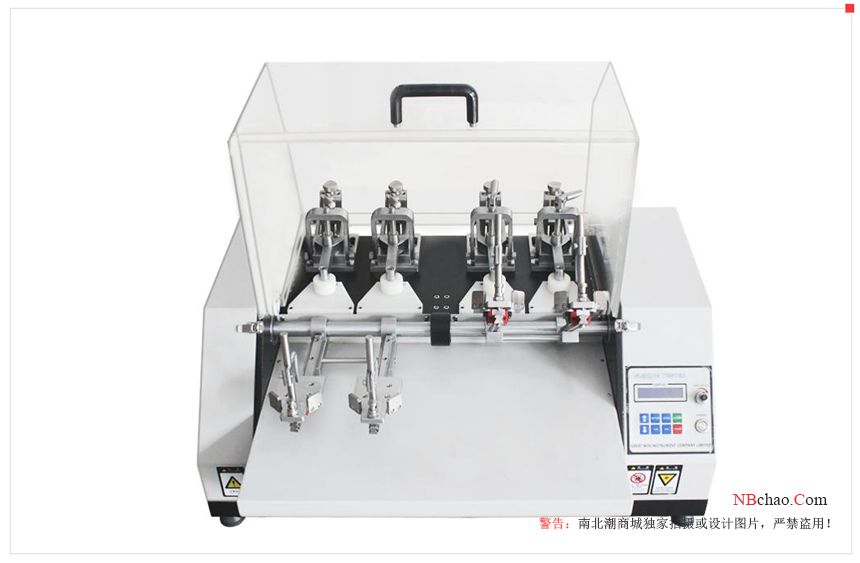
Q: What is the rationale behind the NBS wear test method?
A: The NBS testing machine uses specimens worn on a rotating drum that is covered with abrasives. Apply a weight and use a consistent force to pull the specimen toward the roller. A testing machine operator measures the strength of a material by evaluating the remaining volume after a test cycle.
Q: Compared with other similar test methods, what are the unique advantages of the NBS wear test method?
Answer: Although the NBS abrasion Tester applies the same principle as other rubber abrasive Testers, the NBS method is specifically designed to test materials with a thickness level of not less than 2.5mm.
Q: How is the NBS wear test done?
A: During testing, technicians follow ASTM D1630 standard guidelines for wear.
First, a technician opens a bridge and secures the meter. The bridge is then raised, allowing the arm to swing back to mount the specimen. Each compound is then installed and secured in the socket.
The operator lowers the arm onto the metal roller. The bridge is lowered and locked into place with a calibration weight on each arm. The technician also calibrates the meter, then sets the number of revolutions for the test. Finally, the operator presses a button to start the wear test.
Before the actual test, the equipment was given a break in operation to allow the new abrasive paper to be conditioned. The test used garnet paper with #40 grit. It is available for 18 runs.
The Grinder can rotate 500 revolutions and uses breaks in the compound. It did a second run at 500 rpm. Standard reference compounds were used for the second run. Compounds were discarded after the run.
In the actual run, the new reference compound was used together with the first three compounds. Then, four compounds were passed through four times. Three compounds were tested each.
First pass, if used to test the first three reference compounds. The second pass is for the first two reference compounds as well as the new compound. The third pass is the third, and the new compound as well as the first compound. The last pass tests the new compound, and the second and third reference compounds.
Operators run the NBS Tester until the surface of the compound matches the shape of the drum. Gauges and tachometers are set to zero. Then, the operator restarts the test program.
The Tester runs until 0.1 inch is scraped from the compound. The gauge indicates the amount of material scraped off. The technician records the reading and revolutions of each gauge. He then calculated the number of revolutions needed to wear 0.1 inch from all of the compound.
The Tester needs to be run again, this time with a new standard reference compound. The reference compound is then removed and a new compound is installed on the arm.
The machine will stop when it has worn 0.1 inch from a new sample set. The operator takes values from the previous two runs in the new calculation.