直流电压测量
注意:正打开或关闭电源时不要进行此项测量,瞬间的强大电压将损坏仪表。
1.将功能转盘置于VDC位置(显示屏将显示V)。
2.将黑色表笔插入负极COM端口,红色表笔插入正极V端口。
3.将表笔尖端接触被测物,确保极性正确(红色连正极,黑色连负极)。
4.在显示屏上读取电压值,显示屏显示了准确的小数点,数值和主副单位。若极性颠倒,数值前将显示负号。
交流电压测量
警告:谨防触电。若表笔长度不够不能接触到某些240V用具插座的带电部位,则可能出现插座有电而读到的数值却为0的情况。因此若无电压显示,应检查表笔是否接触到了插座内的金属接口。
注意:正打开或关闭电源时不要进行此项测量,瞬间的强大电压将损坏仪表。
1.将功能转盘置于VAC档位。
2.将黑色表笔插入负极COM端口,红色表笔插入正极V端口。
3.将表笔尖端接触被测物。
4.读电压值。
直流电流测量
注意:在20A情况下测量时间不能超过30秒否则将可能损坏仪表或表笔。
1.将黑色表笔插入负极COM端口。.
2.测量直流400mA以下的电流,将功能转盘置于mA档位,并将红色表笔插入mA端口。
3.测量直流20A时,将功能转盘置于A档位,并将红色表笔插入20A端口。
4.断开被测电路的电源,在你想测量电流的位置打开电路绝缘层。
5.用黑色表笔接触被测电路的负极,红色表笔接触被测电路的正极。
6.接通电源。
7..显示屏上读取电流值。
交流电流测量
警告:为防触电,请勿在电压超过250V的电路.上测量。
注意:在20A情况下测量时间不能超过30秒,否则将可能损坏仪表或表笔。
1.将黑色表笔插入负极COM端口。
2.测量400mA时,将功能键盘置于mA档位,并将红色表笔插入mA端口。
3.测量20A时,将功能键盘置于A档位,并将红色表笔插入20A端口。
4.断开被测电路的电源,在你想测量电流的位置打开电路绝缘层。
5.用黑色表笔接触被测电路的负极,红色表笔接触被测电路的正极。
6.接通电源。
7.显示屏上读取电流数值。显示屏上显示了准确的小数点,数值,和符号。
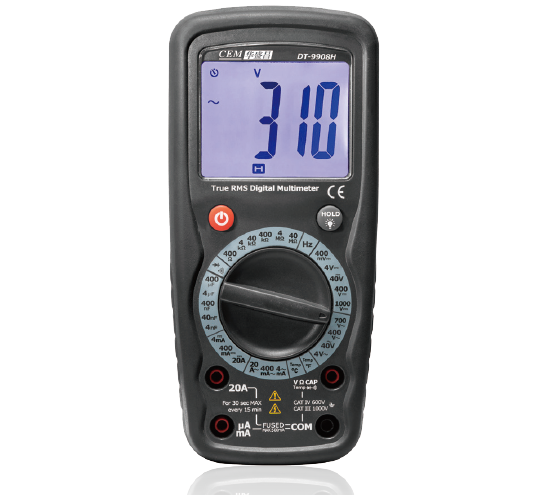
Resistance measurement
Warning: To prevent electric shock, disconnect the power supply, discharge all capacitors, take out the battery and unplug the wire before measurement.
1. Set the function dial to the Ω position.
2. Insert the black test lead into the negative COM port, and the red test lead into the positive Ω port.
3. Touch the test leads to the circuit or component under test. It is better to disconnect one end of the circuit when testing, so that the remaining circuit will not interfere with the measured resistance value.
4. Read the resistance value on the display, and the accurate decimal point, value, and symbol are displayed on the display.
Short circuit buzzer test
Warning: Please do not perform the online short-circuit buzzer test when the power is turned on to avoid electric shock.
1. Set the function dial to  position.
2. Insert the black test lead into the negative COM port, and the red test lead into the positive Ω port.
3. Put the test lead in contact with the object to be measured.
4. When the resistance is less than 50 Ω , the meter will beep and the resistance value will be displayed on the display.
Diode test
Warning: To prevent electric shock, do not test live diodes.
1. Set the function dial to  position.
2. Insert the black test lead into the negative COM port, and the red test lead into the positive Q port.
3. Touch the test lead to the intersection point of the diode or semiconductor to be tested, and record the reading.
4. Change the jack position of the test lead to switch the positive and negative poles of the test lead, and record the reading.
5. Find the state of the diode as follows:
A. If one of the readings is a value and the other is "OL", the diode is in good condition.
B. If both readings are "OL", then the diode is open circuit.
C. If both readings are extremely small or 0, the diode is shorted.
Note: The forward voltage is read during the test.
capacitance measurement
Warning: To prevent electric shock, disconnect the power supply, discharge all capacitors, take out the battery and unplug the wire before measurement.
1. Set the function dial to the CAP position.
2. Insert the black test lead into the negative COM port, and the red test lead into the positive CAP port.
3. Touch the test lead to the measured capacitance and read the capacitance value.
Frequency measurement (DT-9908H)
1. Set the function dial to the Hz position.
2. Insert the black test lead into the negative COM port, and the red test lead into the positive V port.
3. Touch the test leads to the circuit under test.
4. Read the frequency value on the display. The display shows the exact decimal point, value and unit.
Temperature measurement (DT-9908H)
Warning: To prevent electric shock, the test leads cannot touch the power supply before measurement.
1. To read ° F or °C values, set the function dial to ° F or ° C.
2. Insert the temperature probe into the positive Temp port and the negative COM port, be careful not to reverse the polarity.
3. Touch the temperature probe to the object to be measured, and keep the probe in contact with the object to be measured until the value is stable (about 30 seconds).
4. Read the value on the display.
Warning: To prevent electric shock, pull out the temperature probe before performing other tests.



