Tensile strength test is simple and easy to operate, convenient for sample preparation, and is one of the commonly used tests in the mechanical properties of materials. The elastic deformation, plastic deformation, fracture and other stages in the tensile test can truly reflect the whole process of the material resisting the external force. Therefore, the tensile test has great reference value for the detection of metal materials, rubber materials and plastic materials. There are many indicators for testing the tensile properties of plastics. But the two points to sum up are actually the material strength and plasticity data. The key indicators for these two points are tensile strength and elongation at break. Today we will take a closer look at these two indicators.
1. Definitions of tensile strength and elongation at break
1. Tensile strength is the maximum uniform plastic deformation stress of a material. In a tensile test, the tensile strength of the specimen up to the maximum tensile stress fracture is the tensile strength.
2. The elongation at break is expressed in percentage (%), which usually refers to the ratio of the displacement of the sample to the original fracture length
Second, the difference between elongation at break and elongation The stretching process of materials usually includes a plastic deformation stage. Plastic deformation occurs after the yield point, and fracture occurs after reaching the breaking point. Therefore, the elongation at break is usually the elongation of the whole process, and the elongation is usually only the percentage of the elongation at the stage of plastic deformation.
3. Precautions for tensile strength and elongation at break test
1. The length of the sample in the tensile test: the longer the length, the greater the chance of weak rings and the lower the strength. Because the strength is not uniform along the length of the fiber, the fiber always breaks at the weakest point. The longer the sample, the greater the probability of the weakest loop, the greater the likelihood of damage, and reduced strength
2. The number of samples in the tensile test: the more the number, the lower the strength of the single fiber. Because the number of fibers in the bundle is larger, the average single-fiber strength calculated from the strength of the bundle is lower, and the average strength is lower than that of a single stargazing.
3. The tensile speed of the tensile test: the greater the speed, the greater the strength and the greater the initial modulus. Normally, with the increase of tensile speed, the breaking strength, initial modulus and yield stress increase, and the breaking elongation has no regularity.
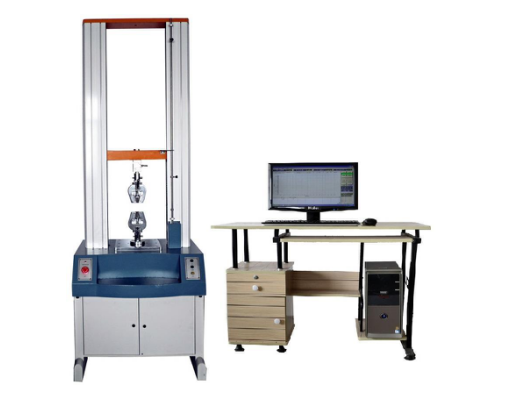
4. Factors Affecting Fiber Tensile Properties
(1) Influence of internal structure on tensile strength
1. Macromolecular structure (macromolecular flexibility, polymer polymerization): Fiber breakage depends on the relative slippage of macromolecules and the breakage of molecular chains. The smaller the average degree of polymerization of the macromolecules, the smaller the binding force of the macromolecules, the easier it is to slip, the lower the fiber strength, and the greater the elongation; on the contrary, the larger the average degree of polymerization of the macromolecules, the stronger the binding force of the macromolecules The larger the value, the less slip that can occur, so the higher the fiber strength, the lower the elongation.
2. Molecular structure (degree of orientation, crystallinity): The higher the degree of orientation, the more parallel the arrangement of macromolecules, the more macromolecules are stressed during stretching, the larger the fiber, the greater the strength, and the smaller the elongation at break. Crack hole defects, morphological structure and inhomogeneity in the fibers result in reduced strength.
The influence of the external environment on the tensile strength temperature and humidity: the temperature and humidity of the air affect the temperature and humidity of the fiber and the moisture regain, thus affecting the strength of the fiber. The influence of temperature on various fibers is not the same, but there is a general rule: under the conditions of high moisture regain, high temperature and large heat energy of fiber macromolecules, the flexibility of macromolecules increases and the bonding strength increases. The intermolecular weakens, the fiber strength decreases, the elongation at break increases, and the tensile modulus decreases. Most fibers increase with the increase of relative humidity, the water content in the fiber increases, the weaker the intermolecular bonding, the looser the crystalline region, so the fiber strength decreases, the elongation increases, and the initial modulus decreases. However, the breaking strength and elongation at break of natural cellulose wool and hemp increased with increasing relative humidity. Among chemical fibers, polyester and polypropylene are basically non-hygroscopic, and their strength and elongation are hardly affected by relative humidity. The effect of relative humidity on fiber strength and elongation varies according to the strength of each hygroscopicity. The greater the moisture absorption capacity, the more significant the effect,
5. Tensile fracture and elongation mechanism When the fiber begins to be stressed, its deformation is mainly due to the fiber stretching macromolecular chain itself, that is, the bond length and bond angle deformation. The tensile curve is close to a straight line, which basically conforms to Hooke's law. When the external force is further increased, the macromolecular chains in the amorphous region overcome the subvalent bonding force between the molecular chains and further stretch the orientation. At this time, a part of the macromolecular chain is straightened, and the tension may be pulled apart, which may be irregular. Extraction of the crystalline fraction. The breakage of subvalent bonds leads to the gradual dislocation slip of the macromolecules in the amorphous region, the fiber deformation is relatively significant, and the modulus gradually decreases, which leads to the fiber entering the yield zone. When the macromolecular chains of the dislocation slip fiber are basically parallel during elongation, the distance between the macromolecules is very close, and new subvalent bonds can be formed between the molecular chains. At this time, the fiber is continuously stretched and deformed mainly through the change of the bond length and bond angle of the molecular chain and the breakage of the secondary bond. When entering the strengthening zone, the fiber mold star increases again until a large number of valence bonds in the fiber macromolecular skeleton are broken, resulting in the disintegration of the fiber. The reasons for fiber breakage are: macromolecular skeleton breakage; sliding loss between macromolecules. Fiber elongation is due to: straightening and elongation of macromolecules (changes in bond lengths and bond angles); modification of orientation; and sliding between macromolecules.