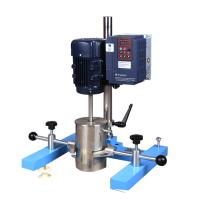
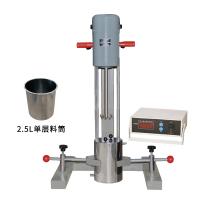
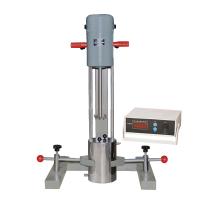
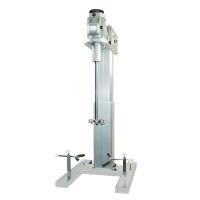
The small-batch pilot disperser concentrates on mixing and dispersing for multiple purposes, and is the most satisfactory experimental equipment for laboratory personnel. It has the advantages of small size, low noise, no commutation interference, no carbon brush mechanical wear, etc., the number directly displays the rotating speed of the shaft, and is equipped with a dispersing impeller. It can adapt to the needs of different experiments in the laboratory, and can directly calculate the relationship between the stirring and dispersing line speed, the viscosity of the material and the chemical reaction rate according to the displayed shaft speed, and provide correct data for large-scale production.

debugging method
1. There should be no clamping phenomenon when turning the shaft by hand;
2. Turn on the power.
3. Loosen the locking bolt, lift up the motor until the material bucket can be put in, fill the material bucket to two-thirds of the water, and put it in the middle of the mixing head.
4. Electric down to the stirring head to the proper position, and the bolts are locked
5. Turn on the main motor, adjust the speed, from low to high, and slowly increase the speed.
Note: It is strictly forbidden to run the machine away from the material.
installation method
1. Check the fastening condition of each connection point.
3. Insert the plug into the 220V socket to power on (the socket needs to be grounded)
4. When working, the mixing head should be completely immersed in the material.
How to use and precautions
1. The rotating shaft should be checked before each start, and the operation is flexible.
2. The starting needs to be carried out in the liquid material, so as not to rotate and hurt people.
3. Feeding suggestion procedure
4. Add the least viscous component to the container and begin mixing.
5. Add the remaining liquid or soluble components.
6. Add solids that require vigorous mechanical stirring or solids that require a certain period of time for chemical reactions.
7. Add the rest of the solids, including those used to build viscosity or stabilize the formulation.
8. After the work is completed, it should be cleaned in time
9. When not in use for a long time, you can remove the working head, drain the water, and add lubricating grease to the sliding bearing.
10. If the stirring head is over 500 rpm, it should run in the barrel to avoid hurting people.