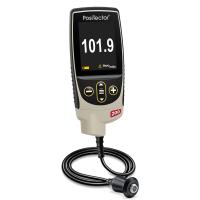
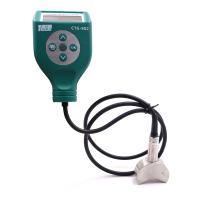
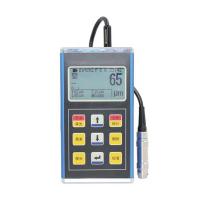
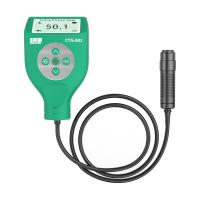
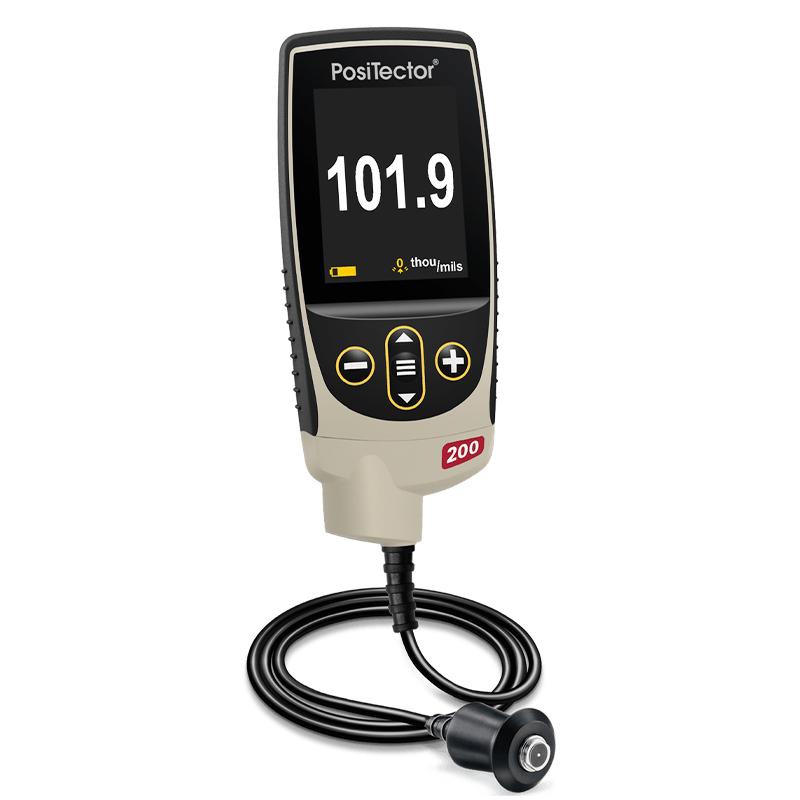
The standard test pieces for the Ultrasonic Coating Thickness Gauge 200 series are:
200B probe, a pack of 5 pieces, the thickness values are about 25/50/125/250/500 microns respectively;
200C and 200D probes, one piece, the thickness value is about 2500 microns.
Note: Standard test strips are not calibration test strips.
The principle of ultrasonic thickness measurement is calculated based on the transmission rate of the pulsed sound wave in the measured object (hereinafter referred to as the material sound velocity) x the transmission time. The instrument collects the transmission time, and the material sound velocity must be artificially set in the instrument.
Ultrasonic Coating Thickness Gauge 200 series is factory-set to the sound velocity of commonly used coatings. For example, 200B, set the sound velocity of conventional plastic paint.
If you use the factory settings to measure the random standard test piece, you will find that the reading is not accurate. This is because the instrument is set to the sound velocity of the paint, which is similar to the sound velocity of the standard test piece, but it is not the same, so the reading is not accurate. .
As for why the standard test piece is not made into the material of the actual paint, it is because the paint cannot be made into the form of a test piece. At the same time, the standard test piece is made of plastic, which is very close to the material of the paint.
Normally no additional calibration is required since most paints have similar sound velocities. However, if it is found that there is a large difference between the measurement reading of the actual workpiece and the actual thickness value, it needs to be calibrated according to the actual workpiece. Specifically:
After obtaining the measurement reading, enter the calibration menu--thickness, and use the up and down keys to adjust the reading to the actual thickness of the measured object. At this time, the setting of the instrument is the sound velocity setting, which is changed from the factory setting to the sound velocity of the actual measured object (although the sound velocity value cannot be reflected in the menu).
Note: The actual thickness of the measured object can be obtained by other methods. The sound velocity of the same paint is the same, so the paint can be applied to a flat workpiece and measured with a dimensional measuring instrument. Or coated on the surface of the metal, measured by conventional electromagnetic method or eddy current instrument.
Although the ultrasonic coating Thickness Gauge is used to measure the coating, because it uses the ultrasonic principle, it is completely different from the principle of using electromagnetic or eddy current for ordinary metal coatings.
The electromagnetic or eddy current Thickness Gauge is based on the change of the magnetic field and the eddy current field, and the thickness value is obtained through the curve relationship between the change amount and the thickness built in the instrument. The instrument has a built-in curve relationship between the amount of change and the thickness, which is a curve drawn according to the normal distribution by collecting many coatings with different thicknesses, measuring the change of field strength. It is impossible for every measurement value to be on the curve, but through calibration, it is possible to ensure that a small range of measurement points is close to the curve as much as possible. Therefore, this kind of coating Thickness Gauge is calibrated to measure the accuracy of the instrument.
For the ultrasonic coating Thickness Gauge, the instrument collects the time difference between the transmitted signal and the reflected signal, the speed of sound * time = distance, this relationship is linear, but the sound speed of each measured material may be different, so ultrasonic coating thickness measurement The meter calibrates the physical properties or materials of the measured object, specifically the transmission rate of sound waves in the measured object.