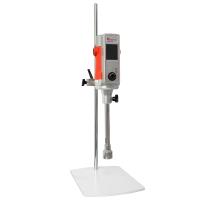
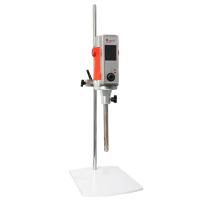
The structure diagram of the working principle of the high shear homogenizer is shown in Figure 1.
The rotating shaft and the rotor are connected by three ribs, and the space formed between the ribs and the rotor has a certain suction force for the material. When the material liquid is stirred and homogeneous in the rotor, the fluid in the rotor is in a turbulent state due to the high-speed rotation of the rotor Theoretically, the turbulent motion of the fluid in the rotor can be described by the Navier-Stokes equation.

In the ultra-thin wall area of the rotor, the fluid motion is significantly affected by the flow conditions of the solid wall (wall shear stress, viscous surface roughness of the feed liquid, etc.), the viscous shear stress is the main characteristic factor, and the turbulent shear stress is extremely Small and negligible. Therefore, the dispersed phase droplets in this extremely thin wall area are mainly controlled by the viscous shear stress of the feed liquid to split and break. In the non-wall area of the rotor (most of the area of the rotor except for the extremely thin wall area), the feed liquid is in a completely turbulent state, the turbulent stress (Reynolds stress) is the main characteristic factor, and the viscous shear stress is extremely small and can be ignored.
Therefore, in this region, the droplet breaks up under the control of turbulent stress.
It can be considered that there is no difference in the statistical characteristics of the pulsating velocity in each direction at any point in the non-wall area of the rotor , that is, the turbulent flow in the non-wall area of the rotor is considered to be isotropic turbulent flow.