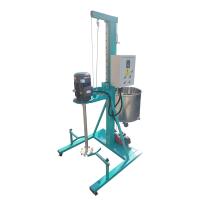
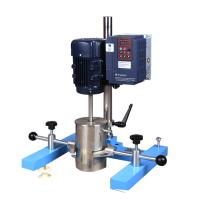
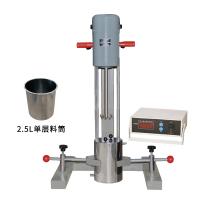
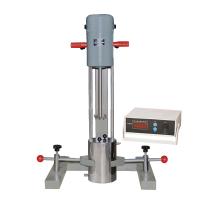
A high-speed disperser is a device that can quickly, effectively and uniformly allow one phase or multiple phases ( solid, liquid, gas ) to enter another immiscible continuous phase (usually liquid). Usually, the different phases are immiscible with each other, and the high-speed disperser provides an external mechanical force so that the two materials can recombine to form a homogeneous phase. The principle of T25 high-speed disperser crushing materials is shown in Figure 2-1 .

As shown in Figure 2-1 , at high speed, the high-speed disperser can generate large mechanical shear force, friction force, eddy force of liquid, etc. on the particles in the gap of the rotor. These forces work together to make the particle size of the material can be uniformly and stably dispersed in the continuous phase.
The speed of T25 high-speed disperser can be adjusted between 3000~20000r/min , which can improve work efficiency with its high speed advantage.
The T25 high-speed disperser was used to prepare three kinds of latex compound aqueous dispersions of ordinary sulfur powder, accelerator ZDC and white carbon black, and the particle size and particle size distribution of various dispersions were measured with a Malvern laser particle size analyzer to study the high-speed disperser The effect of processing time and rotational speed on the quality of the dispersion.
Experimental part
main raw material
Precipitated silica, industrial grade potassium hydroxide ( KOH ), analytical pure ammonia ( NH 3 ·H 2 O ), analytical pure, common sulfur powder ( S ), accelerator ZDC , casein, borax, diffusing agent NF , Pull Open Powder BX , Industrial Grade
Main equipment and instruments
Digital display electric stirrer JJ-l type
Digital display constant temperature Water Bath HH-4 type
Laser particle size analyzer Mastersizer 3000
Electronic Balance YP 2002
High speed disperser IKA T25 digital display type
Sample preparation
(1) Prepare the solution
According to the formula, the substances used in the preparation of the solution were added to the beaker in turn, and stirred evenly. The casein solution and the pull-off powder BX solution need to be heated in a 45°C Water Bath, and after they are completely dissolved, they are bottled for later use.
(2) Compound dispersion
According to the experimental formula, sequentially add compounding agent, casein solution, potassium hydroxide solution, diffusing agent NP solution, and pulling powder BX solution into the beaker, and stir evenly.
(3) Effect of grinding time on dispersion quality
In the case of the same rotational speed (5000r/min for sulfur, 10000r/min for accelerator ZDC and white carbon black) , samples were taken at 0min (ie untreated), 5min, 15min, 20min and 25min respectively. Measure the particle size and particle size distribution of each dispersion with a Malvern laser particle size analyzer, and let the samples stand for the same period of time to observe the change of the dispersion and roughly reflect the amount of sedimentation.
(4) Effect of rotational speed on dispersion quality
Under the situation that the total number of revolutions of the grinding is the same (50000r for sulfur, 100000r for accelerator ZDC and white carbon black) , respectively in untreated and 3000r/min, 5000r/min, 10000r/min, 15000r/min, 17000r/min Process and sample at several rotational speeds. Use the Malvern laser particle size analyzer to measure the particle size and particle size distribution of each dispersion, and let the samples stand for the same period of time to observe the change of the dispersion and roughly reflect amount of sedimentation.