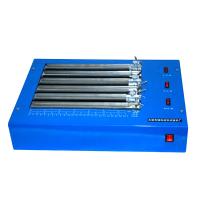
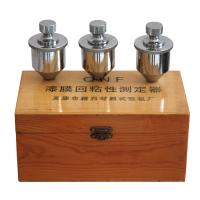
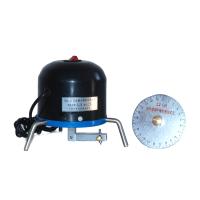
Childhood is a stage when the body's compensatory ability is poor, immunity is low, and body organs are easily damaged. As people's awareness of children's health protection gradually increases, interior wall paint for children's rooms has also become a hot paint on the market. The interior wall paint of children's room is made of synthetic resin emulsion as the base material, formulated with pigments, body pigments and various additives. After application, it can form an interior wall paint with a smooth and thin coating. It is mainly used for interior wall decoration in children's rooms, kindergartens and other children's activity places.
Today we will introduce the regulations of GB/T 34676-2017 on interior wall coatings for children's rooms. Before introducing it, we need to understand its classification. According to the different uses of the product, we divide the interior wall paint of children's room into interior wall primer and interior wall paint.
Item detection
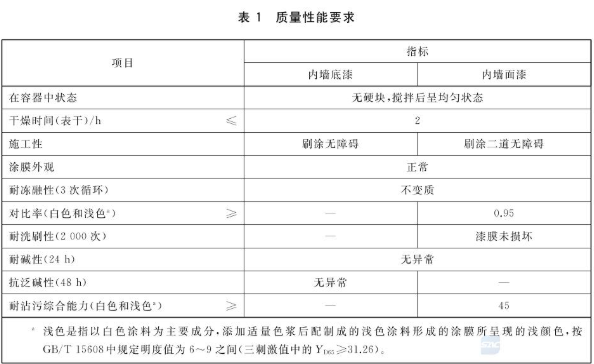
quality performance requirements
1. State in the container: open the container, stir with a spatula or a stirring rod, if there is no precipitation or agglomeration, and it is easy to mix evenly, then it is rated as "no hard lumps, and it is in a uniform state after stirring".
2. Drying time: If surface dry ≤ 2h, it is considered up to standard.
3. Workability: If the interior wall primer sample is brushed on the smooth surface of the test plate with a brush, and the brush runs without difficulty, it will be rated as "no obstacle for brushing"; When the second coat is applied, if the brush runs without difficulty, it is rated as "the second coat is free from obstacles".
4. Appearance of the coating film: After the test, the test panel is placed for 24 hours, and the coating film is visually observed. If there is no significant shrinkage cavity and the coating film is uniform, it is rated as "normal".
5. Freeze-thaw resistance: The sample is subjected to three cyclic tests, and the observation result is that it does not deteriorate, and it is considered to be up to standard.
6. Contrast ratio: The white light color contrast ratio of the interior wall paint sample must be ≥ 0.95 to be considered up to the standard.
7. Scrub resistance: Test the interior wall paint samples for 2000 times, if the paint film is not damaged, it is regarded as up to standard.
8. Alkali resistance: Immerse the sample in the solution for 24 hours, take it out and wipe it dry for observation. If 2 of the 3 test panels do not have any abnormalities in the coating film such as blistering and powder falling, it will be rated as "no abnormality".
9. Pan-alkaline resistance: If the test result of the interior wall primer sample is normal, it is considered to be up to standard.
10. Comprehensive ability of stain resistance: if the white light color of the interior wall paint sample has a stain resistance of ≥ 45, it is considered to be up to the standard.
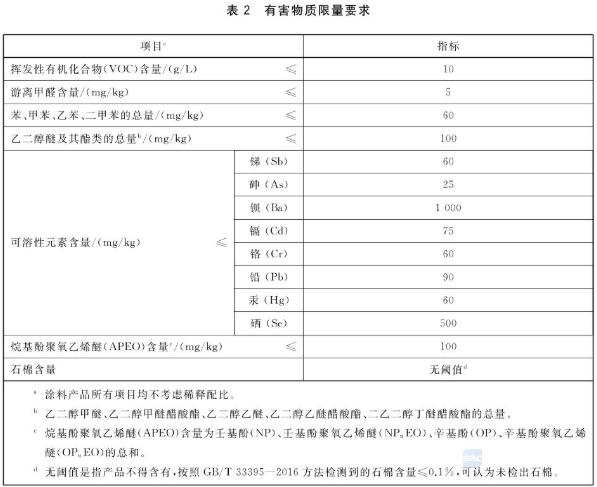
Hazardous Substance Limit Requirements
1. The content of volatile organic compounds must be ≤10g/L
2. Free formaldehyde content should be ≤5mg/kg
3. The total amount of benzene, toluene and ethylbenzene must be ≤60mg/kg
4. The total amount of glycol ethers and their esters must be ≤100mg/kg
5. Content of soluble elements
Antimony (Sb)≤60mg/kg
Arsenic (As)≤25mg/kg
Barium (Ba)≤1000mg/kg
Cadmium (Cd)≤75mg/kg
Chromium (Cr)≤60mg/kg
Lead (Pb)≤90mg/kg
Mercury (Hg)≤60mg/kg
Selenium (Se)≤500mg/kg
6. The content of alkylphenol polyoxyethylene ether should be ≤100mg/kg
7. There is no threshold for asbestos content