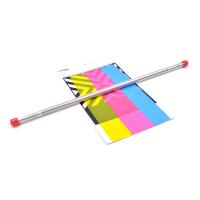
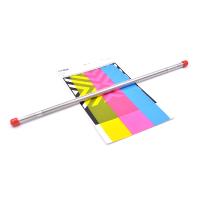
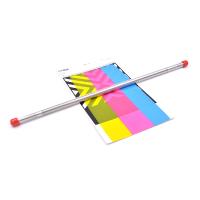
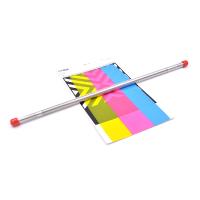
Principle of Wire Bar Coater
The coating thickness is determined by the groove area between the coils as shown. This groove or space allows the proper amount of coating to pass through. The passing amount bleeds or coagulates, leaving a smooth, uniform thickness on the substrate. The groove area is determined by the size of the wire, so the larger the wire, the larger the groove. Precise coating thicknesses from fractions of a mil and higher can be achieved using this coating method. Desired thickness can be repeated again and again with little loss of time and expense. Smudge sticks are available in any length, in a variety of diameters, and on virtually any wire size. They are made of ground and polished steel and the finest wire.

Double Wound Wire Rods - For applications requiring heavier coatings, use these special pull down rods with two wires. A standard single wire is wound around the helix of the base wire with a second smaller wire. The result is an improved groove between wires that will produce wet coatings up to 11 mil (0.011") thick.


Double Coated Rods: Another advantage is that by using dual wire rods instead of traditional single wire rods, the number of "grooves" will more than double for a given coating thickness. This results in higher raised striations being affected by surface tension more quickly and flattening to a glassy surface in a shorter time span.
Gap Rods: For higher viscosity materials, gap rods reduce clogging and eliminate lines. By winding smaller wires at pitches (see photo), the cavity created is wide and shallow, allowing thick coatings to flow better. Smaller wires create smaller interruptions in the coating flow, allowing for more complete wetting of the coating. While gapped rods are not as durable as double-coated rods, they are usually less expensive. Spacer bars are used for coatings up to 25 mil (0.025") thick.
Application field
| Adhesive | lotion | photographic paper |
| board | filler | pigment |
| Cellulose | floor polish | plastic |
| ceramic color | lacquerware | Printing ink |
| cosmetic | mineral powder | resin |
| desiccant | oil | varnish |
| copy ink | Paper | Wax and Hot Melt |