What does the Vickers hardness test mean?
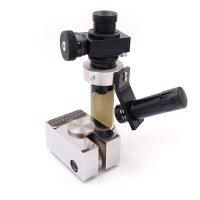
The Vickers hardness test is a test used to measure the hardness of materials, especially thin sections and small parts. It consists of a diamond indenter and a light load to create an indentation on the measured object. The indentation depth is converted to the hardness value of the object.
The smaller the indentation, the harder the object. Likewise, if the indentation is large, the material lacks hardness. This test is used by many industries to determine the correct type of material for operations and machinery. Materials with satisfactory hardness should be selected according to the application.
The Vickers hardness test is also known as the microhardness test.
Vickers hardness test
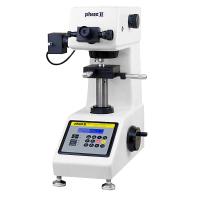
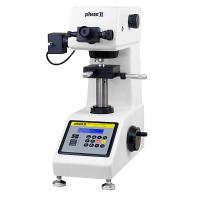
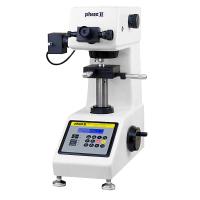
Vickers hardness testing is done by pressing a specific indenter into the surface being tested. Unlike other types of hardness testing, such as the Rockwell hardness test, it uses only one test force. The resulting indentation is measured with high magnification instruments such as eyepieces and microscopes. Some even utilize analysis software for faster and more accurate results.
The Vickers test uses two different forces, for example in the macroscopic range from 1 to 100 kg and in the microscopic range from 10 to 100 grams. The indenter used on both ranges is the same. Therefore, the resulting hardness value is constant across all metal hardness ranges.
Due to the small indentation produced by the Vickers test, it is useful for applications such as testing very thin objects such as foils. It is also excellent for measuring small surfaces or parts, single microstructures or for measuring case hardening by segmenting the part and producing a series of indentations to determine the hardness profile.
In order to obtain accurate results, sample preparation is necessary. A sample small enough to fit on the Tester is required. In addition, the formulation should have a smooth surface to achieve regular indentation shapes and accurate measurements. This also ensures that the object can be held vertically on the indenter.