Since all polymers contain a distribution of molecules of different masses, it is common to define the mean of the distribution:
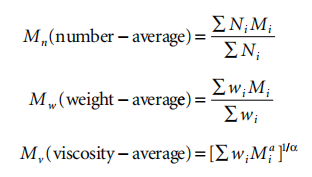
where Ni = number of molecules with molar mass Mi , and w their weights, α is the Mark–Houwink index defined as

where Ni = number of molecules with molar mass Mi
, and their weights, α is the Mark–Houwink exponent, defined by [η], where [η] is the intrinsic viscosity.
The amount of Mn is usually measured by nuclear magnetic resonance (NMR) spectroscopy or osmometry; Mw can be obtained by light scattering techniques, while intrinsic viscosity measurements yield estimates of Mv, size exclusion chromatography or gel permeation chromatography ( GPA) can in principle be used to obtain all of the above averages; care needs to be taken to ensure that the column is properly calibrated using standards with the same molecular structure as the target polymer.
Although there are different definitions for the breadth of a distribution, we will use the common one involving the mean above:

A uniform value of this quantity defines a "narrow distribution" polymer; a value of 2 is obtained in polycondensates, with higher values indicating a considerable molecular weight. This amount can be measured by GPC or a combination of NMR and light scattering techniques.
