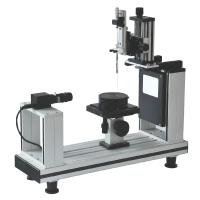
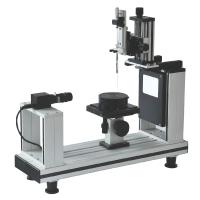
When a drop of liquid is placed on a smooth, flat and level solid surface, the liquid either spreads out to form a thin surface film, or forms a sessile droplet on the surface. Droplets have a finite contact angle. The size of the contact angle depends on the gravitational force between the solid and the liquid and the surface tension of the liquid. Contact angle balance has received considerable attention mainly because it may be a simple direct experimental method to study the thermodynamic work of adhesion.
Many years ago, Young proposed that the contact angle represents the vectorial balance of three tensors, the surface tension of a solid in air (Ysa), the surface tension of a liquid in equilibrium with vapor (Yw), and the interfacial tension between a solid and a liquid (Ys), the balance of forces can be written as
Young's equation has been criticized for being poorly defined in the surface tension of solids, but most surface chemists consider his equation acceptable on theoretical grounds .
This equation can be written as a balance of forces or as a balance of energy because surface tension, expressed as force per unit length, will require the same amount of energy expended when it creates a new surface per unit area.
Huggins and Livingston? recognized the need to modify Young's equation when an exposed solid surface carries an adsorbed liquid vapor film. The solid-"air+steam" tensor Ysw is smaller than the solid-air tensor Ysa. Huggins and Livingston introduced the noun ne to denote such a reduction:


Figure 5.1 Contact angle balance of surface tension and interfacial tension.
revisedYoung's equation also becomes corresponding

The work of adhesion (W) is the thermodynamic work necessary to separate the liquid from the solid without doing any additional work, such as viscous deformation or elastic deformation of the liquid or solid. Dupré3 is considered the definition of adhesion work. When the liquid separates from the solid, new solid-gas and liquid-gas interfaces are created, while the solid-liquid interface is destroyed.
The Dupré equation becomes

Combining the above two equations gives:

In some cases, πe is negligible and Equation 5.5 simply reduces to the original Young-Dupré equation:

Adhesion is then obtained by measuring the surface tension and contact angle of the liquid.
Zissman and his colleagues at the Naval Research Laboratory have studied the contact angles of liquids and solids extensively and carefully. They found that when the surface tension of a set of liquids corresponds to the cosine of their contact angle on a given solid, the data fall along a relatively straight line, somewhat scattered. The surface tension value at which this line intersects the ordinate [ie cos 9 = 1.00 (or 9 = 0°)] is designated as the critical surface tension y.
Some people equate a solid's y with its surface tension or surface energy, but Zisman never did, nor condoned. The critical surface tension of a solid is the highest surface tension that diffuses to a solid in the surface tension of a liquid. It is, of course, a measure of the attractive force that a liquid experiences when it comes into contact with a solid.


Figure 5.3 Work of adhesion of a liquid on a surface with y = 21.5 ergs/cm.
Some have hypothesized that a contact angle of 0° is required to form a strong adhesive bond. This is said to be a necessary condition for moisture. Wet, however, is a relative term. Even if the contact angle is greater than 0°, the molecules of the liquid and solid must be in close contact at the interface. In fact, if we measure the work of adhesion between a set of liquids and a set of solids, we find that, as shown in Figure 5.3, the work of adhesion can be maximized at relatively high contact angles.
Therefore, extension is not a necessary condition for good adhesion on a thermodynamic basis, but it may be highly desirable in practical situations to maximize the contact area and reduce interfacial imperfections and imperfections.