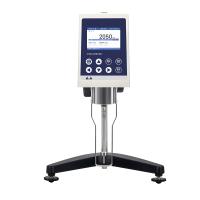
旋转粘度计广泛用于测量油脂、油漆、涂料、塑料、食品、药品、粘合剂等各种流体的动态粘度。因其结构简单、价格便宜、方便实用而广受欢迎。但在与客户沟通的过程中,发现很多客户对如何正确使用旋转粘度计存在一些疑问。现在就告诉您旋转粘度计的正确使用方法,让您更有效、更方便地使用旋转粘度计。

旋转粘度计的测量原理
一、启动旋转粘度计后,应检测零位。该操作通常在不安装转子的情况下进行。然后将半径为R2的内筒安装在半径为R1的外筒中,内筒内充满粘性流体。接下来,同步电机以稳定的速度旋转并与刻度盘连接。然后,由游丝和轴驱动内筒旋转。此时,内筒会受到流体粘滞力矩的影响。效果越大,游丝抵抗粘滞力矩产生的扭矩越大,指针指示的刻度也越大。最后,将读数乘以特定系数,得到液体的动态粘度。
如何正确使用旋转粘度计?
According to刚才解释的旋转粘度计的测量原理,为了获得准确可靠的测量数据,使用时需要注意以下几点:
1、旋转粘度计的性能指标需要符合国家检测要求。并对已投入使用的旋转粘度计进行定期检定,必要时(仪器使用频繁或处于合格临界状态)进行中间自检,确定其测量性能是否合格以及系数误差是否在允许范围内,否则旋转粘度计无法获得准确数据。
数显旋转粘度计2. 用户应特别注意旋转粘度计中被测液体的温度,这一点很容易被忽略,因为他们通常认为轻微的温差没有影响。但实验证明:当温度偏差为0.5℃时,有的液体粘度值偏差会超过5%。因此,温度偏差对粘度有很大影响。一旦温度升高,粘度就会降低。因此,应特别注意保持被测液体的温度恒定,与规定温度的偏差不得超过0.1℃。
3. 选择正确的测量容器(外筒)。在使用双筒旋转粘度计之前,请仔细阅读说明书。不同的转子(内筒)有对应的外筒。如果它们没有正确匹配,测量结果会出现很大偏差。但在使用单筒旋转粘度计时,外筒的半径是无限大的,实际测量时外筒的实际直径不应小于特定尺寸。
4. Correctly select the rotor or adjust the speed to ensure that the displayed value is between 20 and 90 divisions. Because the rotary viscometer reads through the dial and pointer, the stability and reading deviation are 0.5 divisions. If the reading is too small, such as about 5 divisions, the error will be more than 10%; if the reading is above 90 divisions, the torque generated by the hairspring will be very large, and the viscometer will easily generate pressure, which will damage the hairspring. But by choosing the correct rotor or speed so that the reading is 50 divisions, the error can be reduced to 1%. So be sure to choose the appropriate rotor and speed.
5. Pay attention to the influence of immersion depth and air bubbles. Rotational viscometers have strict requirements on the depth of liquid immersion into the rotor and need to be operated according to the instructions (some double-cylinder Rotational Viscometers have strict requirements on the amount of liquid to be measured and need to be measured with a graduated cylinder). Because the rotor often has air bubbles during the soaking process, after the rotor rotates for a period of time, most of the air bubbles will float up and disappear, but sometimes the air bubbles attached to the lower part of the rotor cannot be eliminated, and the existence of air bubbles will bring great deviations to the measurement data , so slowly immersing the rotor is an effective way to avoid it.
6. Pay attention to cleaning the rotor. Make sure there is no dirt before measuring the viscosity with the Rotational Viscometer, and clean it immediately after the measurement, especially after measuring paints and adhesives. Also pay attention to the cleaning method: soak with a suitable organic solvent, and do not scrape with metal tools. Because severe scratches can cause deviations in the measurement results.
7. Most of the instruments on the Rotational Viscometer need to be adjusted to keep it level. Always pay attention to the level problem when measuring, otherwise the reading will be deviated or even impossible to read.
8. Certain instruments on the Rotational Viscometer require a protective stand. So please read the instructions carefully and start the installation.
9. Determine whether the sample to be tested in the Rotational Viscometer is a Newtonian fluid. For non-Newtonian fluids, the appropriate rotor, rotational speed and rotation time should be selected so as not to mistake the instrument for inaccuracy.
To sum up, although the Rotational Viscometer has a simple structure and is easy to use, if it is not used properly, a qualified Rotational Viscometer will not be able to obtain accurate measurement results.