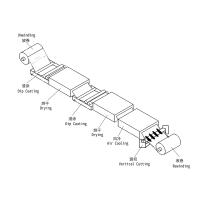
Spray and Dip Use well-prepared and diluted batches of paint in the pan, stirring to ensure uniformity. The paint is then transferred to the workpiece until the pot is empty. Against this, electrodeposition basically only transfers paint solids to the workpiece. So, after the painting is done, the can is still filled with the water-based portion of the paint, except that the paint bath increments have been lifted out. These volumes of bath should not be flushed back into the tank with water as this would cause the tank to overflow. Thus, a portion of the bath is passed through the ultrafilter, which retains the paint solids, while the aqueous phase passes through filtration or osmosis. The freshly painted workpiece is then rinsed with ultrafiltrate and the lifted paint is returned to the tank. For the same reason, a more concentrated paint is used instead of painted solids. The chemistry of paint dispersion and deposition can be expressed by the following equations:


Both processes use base or acid as an external solubilizer, and the equations indicate that most of the solubilizer remains in the bath. Therefore, it is necessary to use insufficiently dissolved paint as a raw material, and the plating solution provides its excess solubilizer to balance the demand.
A promising invention uses self-dissolving cathode materials called sulfonium bases.

throwing power
Throw force and narrow spacers are measured as the depth of the deposited coating in a standard cavity formed by the test panel . In fact, an important feature of the electrocoating process is the ability to extend a durable paint film into extreme recesses, such as car doors.
While throwing power is a property of the paint, it can be increased by higher applied voltage and higher bath conductivity (helps transport power into the groove), lower paint requirement per gram coulombs (more Efficient use of electricity), larger openings for access to cavities, and larger perimeters of openings. In other words, slits are more efficient than round holes.
keep steady
Unlike other painting processes, electrophoresis tanks operate similarly to electroplating in that a balance of incoming and outgoing material is necessary. Paint solids and evaporated water and other materials that are accidentally lost need to be replaced. More precisely, the initial tank filling recipe is to provide one or more test pieces, meeting all required robustness. For example, a certain combination of resins, pigments, solvents, crosslinkers, and other materials provide the desired deposited coating. Paints, however, may contain these ingredients in slightly different proportions. Typically, a tank fill of 70 % resin plus 30% pigment by weight yields a deposited coating of 68% resin plus 32% pigment by weight. If so, the paint replenishment (feed) needs to be richer in pigment than the original composition (fill). In general, feed is required to replace all material leaving the tank. It's just an analysis problem, but it can be troublesome until it's solved.
Burst voltage
Among the factors that increase projection capability, increasing voltage is the easiest to apply. However, there is a limit called the burst voltage. This appears to be a dielectric breakthrough for film formation, which depends on the metal surface being coated. Regardless, when voltages are applied above the burst voltage, blemishes (pitting) films and lower solids (reduced salt spray resistance, etc.) result.