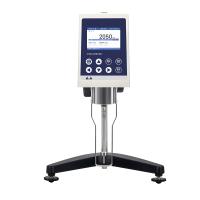
Rotational viscometers are widely used to measure the dynamic viscosity of various fluids such as oils, paints, coatings, plastics, food, pharmaceuticals, and adhesives. It is popular because of its simple structure, cheap price, convenience and practicality. But in the process of communicating with customers, it is found that many customers have some doubts about how to use the Rotational Viscometer correctly. Now tell you the correct use of the Rotational Viscometer, so that you can use the Rotational Viscometer more effectively and conveniently.
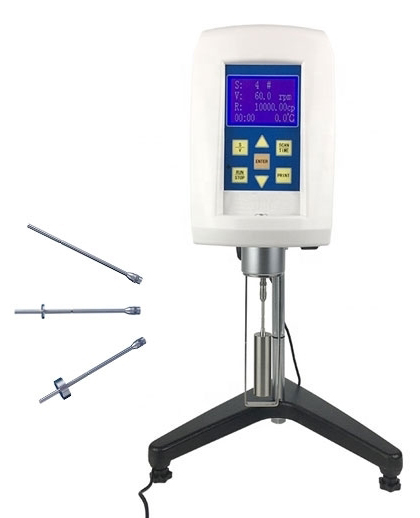
Measuring principle of Rotational Viscometer
1. After starting the rotary viscometer, the zero position should be checked. This operation is usually performed without installing the rotor. Then the inner cylinder with radius R2 is installed in the outer cylinder with radius R1, and the inner cylinder is filled with viscous fluid. Next, a synchronous motor rotates at a steady speed and is connected to the dial. Then, the inner cylinder is driven to rotate by the balance spring and the shaft. At this time, the inner cylinder is affected by the viscous moment of the fluid. The greater the effect, the greater the torque generated by the hairspring resisting the viscous moment, and the greater the scale indicated by the pointer. Finally, the reading is multiplied by a specific factor to obtain the dynamic viscosity of the liquid.
How to use the Rotational Viscometer correctly?
According to the measurement principle of the Rotational Viscometer just explained, in order to obtain accurate and reliable measurement data, the following points should be paid attention to when using it:
1. The performance indicators of the Rotational Viscometer must meet the national testing requirements. And carry out regular verification of the Rotational Viscometer that has been put into use, and conduct intermediate self-inspection when necessary (the instrument is frequently used or in a qualified critical state) to determine whether its measurement performance is qualified and whether the coefficient error is within the allowable range, otherwise the Rotational Viscometer cannot Get accurate data.
2. Users should pay special attention to the temperature of the measured liquid in the Rotational Viscometer, which is easily overlooked, because they usually think that a slight temperature difference has no effect. However, experiments have proved that when the temperature deviation is 0.5°C, the deviation of the viscosity value of some liquids will exceed 5%. Therefore, the temperature deviation has a great influence on the viscosity. Once the temperature increases, the viscosity decreases. Therefore, special attention should be paid to keep the temperature of the measured liquid constant, and the deviation from the specified temperature should not exceed 0.1°C.
3. Select the correct measuring vessel (outer cylinder). Before using the dual cylinder Rotational Viscometer, please read the instructions carefully. Different rotors (inner cylinders) have corresponding outer cylinders. If they are not matched correctly, the measurement results will be greatly skewed. However, when using a single-cylinder rotary viscometer, the radius of the outer cylinder is infinite, and the actual diameter of the outer cylinder should not be less than a specific size during actual measurement.
4. Correctly select the rotor or adjust the speed to ensure that the displayed value is between 20 and 90 divisions. Because the rotary viscometer reads through the dial and pointer, the stability and reading deviation are 0.5 divisions. If the reading is too small, such as about 5 divisions, the error will be more than 10%; if the reading is above 90 divisions, the torque generated by the hairspring will be very large, and the viscometer will easily generate pressure, which will damage the hairspring. But by choosing the correct rotor or speed so that the reading is 50 divisions, the error can be reduced to 1%. So be sure to choose the appropriate rotor and speed.
5. Pay attention to the influence of immersion depth and air bubbles. Rotational viscometers have strict requirements on the depth of liquid immersion into the rotor and need to be operated according to the instructions (some double-cylinder Rotational Viscometers have strict requirements on the amount of liquid to be measured and need to be measured with a graduated cylinder). Because the rotor often has air bubbles during the soaking process, after the rotor rotates for a period of time, most of the air bubbles will float up and disappear, but sometimes the air bubbles attached to the lower part of the rotor cannot be eliminated, and the existence of air bubbles will bring great deviations to the measurement data , so slowly immersing the rotor is an effective way to avoid it.
6. Pay attention to cleaning the rotor. Make sure there is no dirt before measuring the viscosity with the Rotational Viscometer, and clean it immediately after the measurement, especially after measuring paints and adhesives. Also pay attention to the cleaning method: soak with a suitable organic solvent, and do not scrape with metal tools. Because severe scratches can cause deviations in the measurement results.
7. Most of the instruments on the Rotational Viscometer need to be adjusted to keep it level. Always pay attention to the level problem when measuring, otherwise the reading will be deviated or even impossible to read.
8. Certain instruments on the Rotational Viscometer require a protective stand. So please read the instructions carefully and start the installation.
9. Determine whether the sample to be tested in the Rotational Viscometer is a Newtonian fluid. For non-Newtonian fluids, the appropriate rotor, rotational speed and rotation time should be selected so as not to mistake the instrument for inaccuracy.
To sum up, although the Rotational Viscometer has a simple structure and is easy to use, if it is not used properly, a qualified Rotational Viscometer will not be able to obtain accurate measurement results.