Advances in source and materials technology for high-speed, vacuum, and web coating operations have produced a variety of products of interest to the process industry, including transparent glass barrier coatings and anti-abrasion for windows, solar cells, and packaging films and sheets/ Anti-reflective coating. The process of preparing plastic films with glass barrier coatings by plasma deposition and plasma polymerization offers new alternatives for the coatings industry. Anti-abrasion/anti-reflective coatings on plastic films should have the following physical properties: index in the range of 1.3 to 1.4 (lower is better) ; , then at least for the top layer; hard surface; low coefficient of friction; and weather and stain resistance for glass applications.
Source and deposition environments are designed to suit the desired material, material structure, and coating level. For barrier and anti-wear/anti-reflective coatings made of oxides at high speed, three plasmas are used: one for cleaning the substrate and providing the necessary polar surfaces for good nucleation and adhesion, close to The plasma of the source ionizes most of the deposited material to provide energy for the migration and close packing of adatoms, and provides a tighter packing of the plasma for coating annealing .
The coating process is usually performed under high vacuum to avoid the interaction of the background gas with the material being deposited. A high vacuum helps avoid electrons and photons from heating the substrate. Since the well-nucleated, low lateral stress oxide barrier has an elongation of about 5%, they can be processed through web-handling machine drums. Poor nucleation can lead to non-barrier columnar structures even if the coating is amorphous. Plasma-activated barrier properties increased by an order of magnitude. CVD of SiOx on polyester can be obtained by plasma pretreatment of helium or methane. This pretreatment is recommended to be done in-line, but will not eliminate the need for corona treatment at atmospheric pressure.
The high vacuum in the plasma-activated CVD process prevents nucleation in the gas phase, and the high vacuum in the electron beam during deposition, the low pressure allows adatoms to reach the substrate with high kinetic and electronic excitation energies.
The main differences between plasma activated CVD and e-beam processes are as follows:
1. The e-beam process requires a separate plasma to clean and nucleate the substrate, ionize the adatoms, and anneal the coating. In a plasma-activated CVD process, these three plasmas are combined into one.
2. Plasma-activated CVD has a higher pressure than e-beam CVD, so when e- beam coatings are deposited in line of sight and form pinholes around dust particles, plasma-activated CVD tends to incorporate dust particles into the coating.
3. The higher pressure of plasma-activated CVD allows the background inert gas to remove most of the condensation heat before reaching the substrate, so plasma-activated CVD does not require a cold drum.
There are two complementary approaches to improve the barrier properties of SiOx - modification of the cations of the deposition material and modification of the deposition source. Modifiers or substitutions because silica can lower its porosity, melting point, and solubility, and can change its nucleation density or refractive index to match that of adjacent materials.
Silica is the preferred main component because of its unusual glass-forming ability to resist crystallization on cooling and the consequent high elastic elongation. Some of the materials that have been shown to enhance one or more of these properties of SiO include magnesium, carbon, barium, boron, aluminum, germanium, zinc and titanium.
For example, a glass containing 35% magnesia and 65% SiO has a lower melting point, allowing the film to anneal and increase its bulk density before solidification. Silica dissolves slowly in water, and about 10% zirconium prevents acid and alkali attack. It has been determined that its x-factor in SiOx varies from 1.55 to 1.8, the oxygen transmission rate varies from 0.1 to 0.4, and the film turns yellow with increasing barrier properties.
High-speed deposition techniques other than e-beam for barrier and anti-wear/anti-reflective coating production, including new methods for CVD. Coatings on these plastics can be made by two closely related processes: plasma-activated CVD and plasma polymerization. Similar equipment was used for both procedures.
For applications requiring a high refractive index, tetraalkoxytitanium compounds are non-volatile and non-toxic, so they can replace siloxanes to produce titanium dioxide coatings as starting materials to produce intermediate refractive indices. These processes have three advantages over e-beam coating: they are conformal because they are fabricated at relatively high pressures; and because a wider range of activation can be obtained when materials and reaction conditions are available. The chemical bond structure of the oxide is created in the coating, or the coating can be tailored to the flexibility or hardness of the polymer oxide ; and the thermal load on the coated plastic is much lower, so no cooling is required.
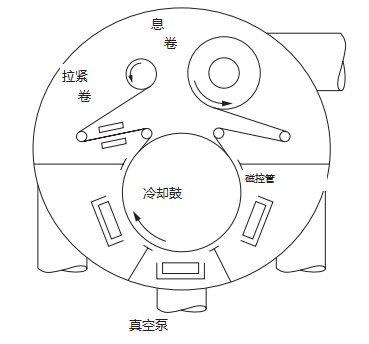
Figure 32.14 Cross section of a sputter roll coater.
This is the result of the adatoms agglomerating in the gas phase into liquid particles large enough to greatly reduce the condensation heat load on the substrate, energetic enough to allow the adatoms to anneal and tightly packed fluidity, yet small and hot enough to prevent "snow" form. The main disadvantage of plasma-activated CVD is that, for most coatings, the starting materials are often highly toxic and sometimes pyrophoric.
Materials that are plasma polymerized include methane, ethane, ethylene, tetrafluoroethylene, methylene acrylate, methacrylate, and other monomers. Plasma-polymerized coatings differ from bulk polymers made from the same monomers in that they are highly cross-linked, so they are less specific elastic. The oxygen transmission rate of plasma-polymerized barriers has been reported to be less than 0.01.
One of the advantages of plastic film with a glass barrier coating is that it can be recycled. Plastic films with glass barrier coatings can be reextruded, whereas coextruded polymer barrier layers cannot. Most likely, SiO1.8 will remain the main component of glass barrier coatings. Its bonds are flexible with respect to angle and length, endowing the coating with high elastic elongation and resistance to crystallization during coating. It has a low index of refraction, so it doesn't add glare to plastic films. It is also relatively insoluble. The oxygen transmission rate of the coating film is 0.02 cc/100 in2/day to 0.06 cc/100 in2/day, and the water vapor transmission rate is 0.05 g/100 in2/day to 0.07 g/100 in2/day.
In many cases, reactive magnetron sputtering is the deposition process of choice. This is a proven industrial deposition process for coating webs on films such as Kapton. Reactive sputtering for maximum control over the coating process and high deposition rates. There are many possibilities for variation in this process, including plasma deposition (introducing additional silicon as silane in the discharge to increase the deposition rate) and plasma polymerization.
Figure 32.14 shows a cross-section of a sputter roll coater. A roll of film is unwound in a vacuum, through which the cooling drum stabilizes the film as it is coated by one or more magnetron sputtering sources, and the coating properties are monitored in-line before the film is rewound. This configuration allows continuous monitoring and feedback control for coating process and performance. Various optics can monitor electrical properties, depending on the coating being fabricated.
