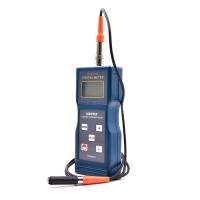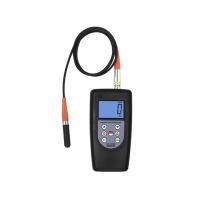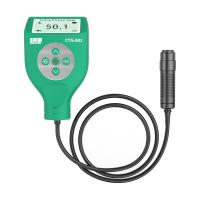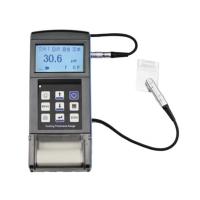
1) Magnetic induction principle:
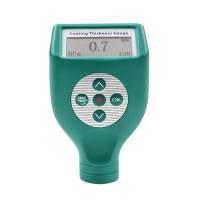
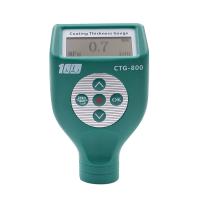
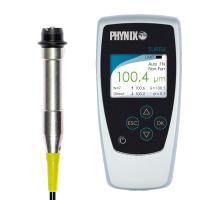
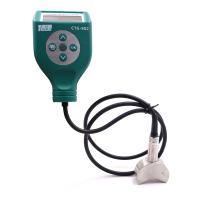
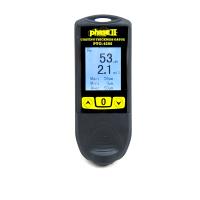
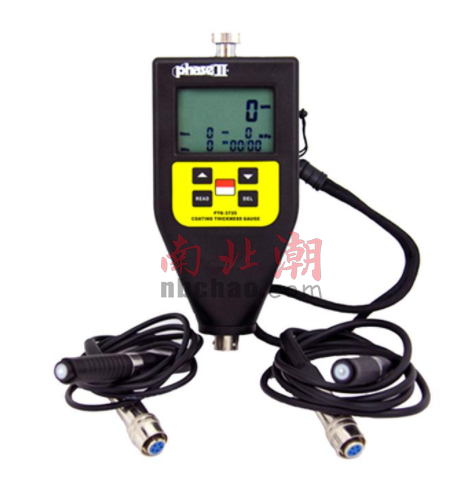
The Phase II PTG Series Coating Thickness Gauge utilizes this non-destructive principle to measure coatings on ferromagnetic substrates such as steel and iron. Coatings need to be non-magnetic such as: paint, enamel, aluminium, chrome, copper and brass.
2) Eddy current principle:
The Phase II PTG Series Coating Thickness Gauge utilizes this non-destructive principle when measuring coatings on non-magnetic substrates such as: Aluminum, Aluminum Alloys, Bronze, Copper, Brass Tin and Rust-Resistant Weak Magnetic Steel. Coatings need to be electrically insulating such as: paints, enamel, plastics, anodized coatings and ceramics.
Calibration procedure
Note: All PTG Series coating Thickness Gauges are checked and calibrated using a two-point calibration procedure prior to shipment.
1) Single point calibration:
This process is done by "zeroing" the gauge on the uncoated version of the sample you will be checking for coating thickness. To accomplish this calibration, you will need to follow a simple calibration procedure described in the operator's manual. While this is an accurate calibration method, it is not as accurate as using a two-point calibration.
2) Two-point calibration:
This process is done by "zeroing" the gauge on a supplied substrate sample (steel/aluminum), then placing one of the calibrated "foils" on that substrate and calibrating the gauge to match the known foil thickness. It is recommended to use a foil that is closer to the actual known thickness of the sample you are testing yourself. This is a very simple process and is explained in the operating manual. By using a two-point calibration procedure, you can ensure that the meter will be in accurate condition when testing your own coating samples. This is the same method used to calibrate each meter prior to shipment.
3) Calibration frequency:
After the PTG series coating Thickness Gauge is calibrated, the parameters are stored in the memory, and there is no need to repeat the calibration procedure.
We do recommend that after several hours of operation, or if the meter has not been used for several days, you should check the accuracy using the same calibration substrate/foil combination that was used to calibrate the meter previously.