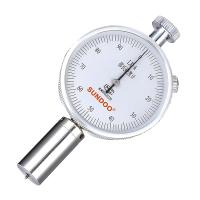
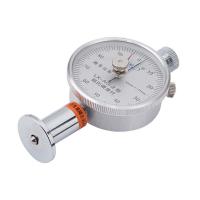
Rubber properties - durometer hardness test
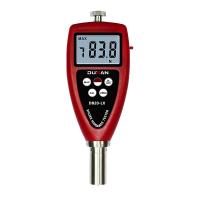
ASTM D2240 – Durometer Hardness is a test method designed to measure the depth of an indentation in a material being tested. Indentations are produced with a given force on a standard indentation head. Depth is proportional to the hardness of the material (also known as Shore hardness), its ductility and the shape of the indenter. ASTM D2240 uses rubber properties and durometer hardness and involves pressing the indentation head on the bottom of the hand-held device until the flat bottom part rests on the surface of the material to be tested.
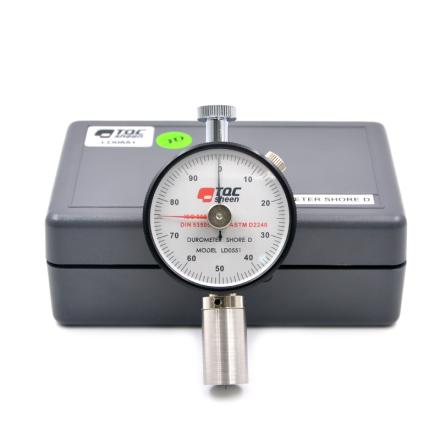
This test method is widely used in composite materials and polymer testing.
ASTM D2240 Uses and Factors to Consider
ASTM D2240 allows the measurement of initial hardness or indentation hardness after a given time. This test requires force to be applied in a consistent manner, without impact, and hardness is measured. There are 12 scales, and there is no mathematical relationship between the various scales because they are arbitrary scales. Therefore, it is important to know which scale you need for your lab.
ASTM D2240 Typical Test Parameters
Initial Hardness or Timed Hardness: Usually Initial Hardness
Specimen shape: flat and homogeneous (no texture)
The durometer to use: The popular durometers are "A" and "D". Together, the two scales cover a range of durometers from rubber to nylon.
Number of samples per product: 1 sample, 5 readings
Sample size: 2” X 2” or larger with a minimum thickness of 6.4 mm (0.25 in.) thick.
Conditioning and testing temperature: 23 ± 2 °C
Conditioning and testing relative humidity: 50±5%