Why measure glossiness?
When considering the psychological impact of a product on consumers, gloss is an aspect of visual perception of objects that is as important as Color.
It is defined as "surface properties that give them a shiny or glossy metallic appearance".
Surface gloss can be greatly affected by many factors, such as the smoothness obtained during polishing, the amount and type of coating applied or the mass of the substrate.
Manufacturers design their products for maximum appeal - high-reflective body panels, gloss magazine covers or satin-black designer furniture.
Therefore, it is important to consistently achieve gloss levels on each product or different batches.
Glossiness can also be a measure of surface mass, for example, a decrease in glossiness on a coated surface may indicate a problem with its curing, leading to Miscellaneous failures such as poor adhesion or a lack of protection on the coated surface.
It is for these reasons that many manufacturing industries monitor the glossiness of their products, from automotive, Printing and Furniture to food, pharmaceuticals and consumer electronics.
What is a Glossiness Meter?
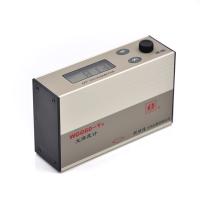
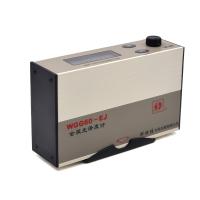
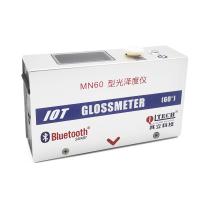
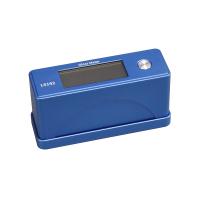
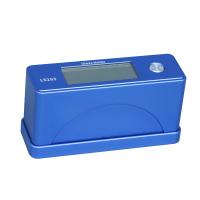
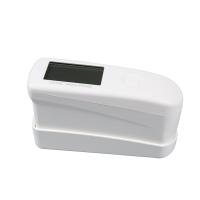
A Glossiness Meter (also known as a Glossiness Meter) is an instrument used for the measurement of specular reflection of a surface, such as glossiness. Glossiness is determined by projecting a beam of light onto a surface at a fixed intensity and angle and measuring the amount of reflected light at equal but opposite angles.

What kind of Glossiness Meter do you need?
Determine the surface you want to measure. Is it flat? If so, it can be measured with a conventional Glossiness Meter.
Surfaces should be measured using equipment designed for such applications. Benchtop and handheld instruments are available for these applications.
Choosing the correct Glossiness Meter depends on the surface application and glossiness. Each Glossiness Meter specifies the Geometry to use.
| Gloss range | 60° | Remarks |
| High gloss | >70 GU | If the measurement exceeds 70 GU at 60 °, change the test setting to 20 ° |
| Medium gloss | 10 – 70 GU | |
| Low gloss | <10 GU | If the measurement is less than 10 GU, change the test setting to 85 ° |
"Geometry" refers to the angle between the incident ray and reflected light. Three Geometry (20 °, 60 °, and 85 °) are specified to cover most coating applications. Choose the angle based on the expected gloss range, as shown in the table below.