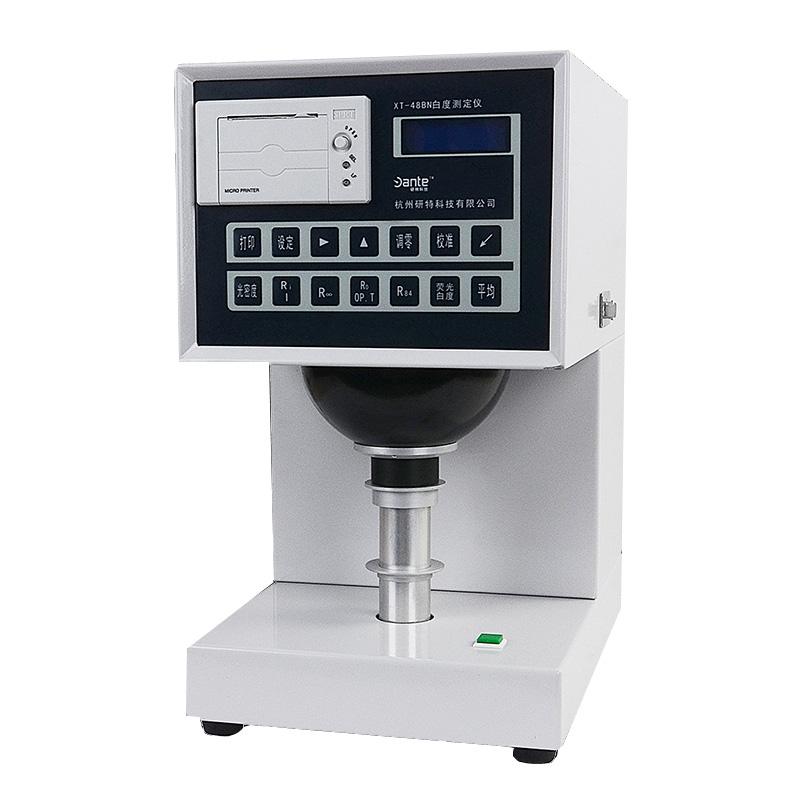
Whiteness Index is a value widely tested in the industry in a variety of materials and carriers
As with paper and board, an essential characteristic for the measurement and characterization of paper supports is the whiteness index. Together with gloss and hue, this index allows the classification of supports according to their optical properties.
However, although the whiteness index is a widely used value in the printing industry, it is not an industry that uses the index. Whiteness is therefore often measured in textiles, pharmaceuticals, ceramic materials, paints or plastics, and many other materials.
What is the whiteness index?
Whiteness is the amount of light reflected by a support as measured by the visible spectrum. This value is obtained by calculating the amount of white light (i.e. the sum of spectrally reflected wavelengths) displayed by the surface. Therefore, this value can be used to determine how well white supports the human eye. Whiteness is measured as a percentage on a scale of 1-100%, where 100% is the value that should correspond to extreme whiteness.
For whiteness measurements, the CIE developed the lighting standard D65, which roughly corresponds to the incidence of the midday sun in Western and Northern Europe.
Whiteness index and gloss are different parameters, although they are measured in percentages. Thus, the first considers the reflection of white light and is measured by the color coordinates by a Spectrophotometer ; the second, which is more difficult to detect, is measured by a Glossmeter.
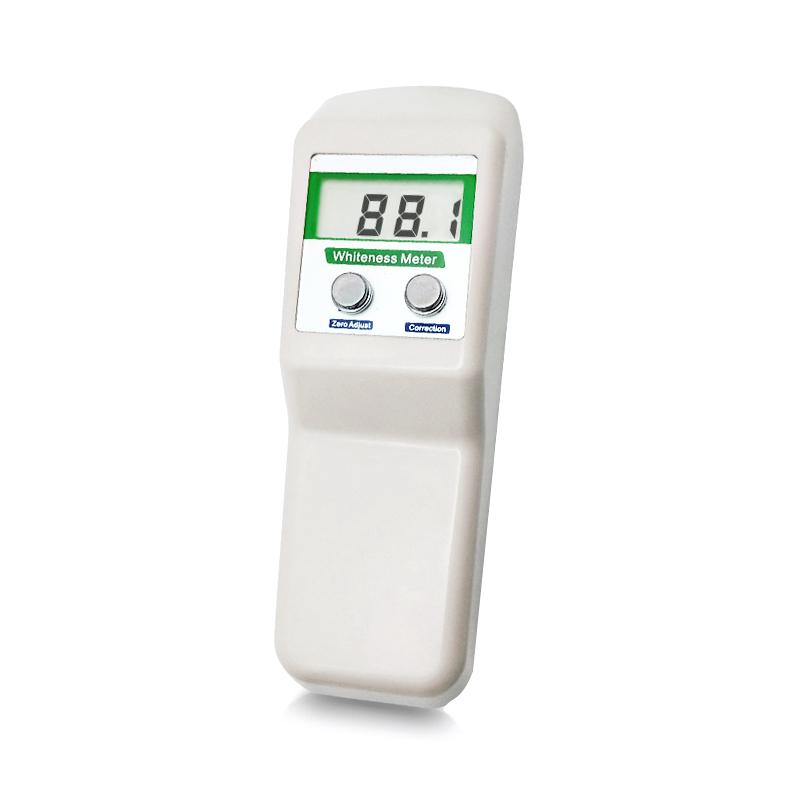
In this way, we can define gloss as a measure of the amount of blue light reflected in a support or material. Therefore, we can say that glossiness is the volume of reflected light, representing a narrower light reflectivity than whiteness.
By itself, whiteness is a measure of the amount of light reflected from a material or support. According to white light reference, we can say it is the quality of light. So different degrees of whiteness make us perceive the material differently. So, at lower levels of whiteness, materials are perceived as neutral, gray, or creamier (yellow); at higher levels of whiteness, we perceive them with a bluish tinge. Therefore, the whiteness index (CIE) is 100 in the reflective and non-fluorescent white samples.