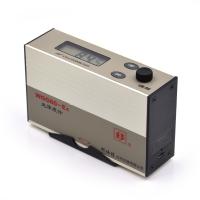
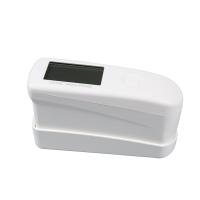
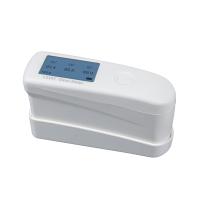
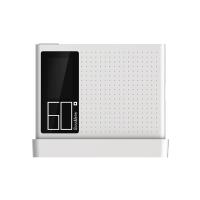
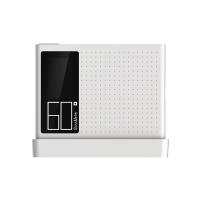
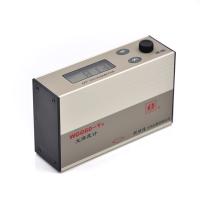
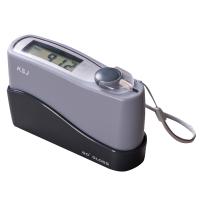
To choose a Glossiness Meter, you first need a flat surface of approximately 2 "x 0.5" (50 x 10mm) to properly position the Glossiness Meter on the surface.
Your product must now be judged by its glossiness. Most products fall into the semi-glossiness range. Some are matte and designed to have very low glossiness, while others such as metal or automotive finishes are very high. There are three types that cover the entire glossiness range, namely 20 degree, 60 degree and 85 degree Glossiness Meters. However, certain industries present different angles. These industries are: Paper, Ceramics, Film and Vinyl. Some customers make a range of products from very gloss to matte and then you need a universal Glossiness Meter to measure all three angles, or you might only make products from half gloss to very high gloss instead of you need DUAL 20-60 degree Glossiness Meter.
Low glossiness - 85 °
To improve resolution with low glossiness, a grazing angle of 85 ° is used for surface measurement. This angle is recommended for surfaces smaller than 10GU for measurement at 60 °. This angle also has a larger measurement point to average out differences in glossiness on textured or slightly uneven surfaces.
Medium or half glossiness - 60 ° - General Geometry
It must be remembered that all glossiness levels can be measured using a standard Geometry of 60 °. This 60 degree angle is used as a reference angle for all products. So why choose another angle from Miscellaneous? Because for extremely high glossiness, one can get better measurement results with complementary angles of 85 ° or 20 °, which are usually used for low and high glossiness levels, respectively.
High glossiness - 20 °
Geometry at an acute angle of 20 ° increases the resolution of high gloss surfaces. Surfaces measuring 70 GU and above at a standard angle of 60 ° are often measured using this geometric shape. The 20 ° angle is more sensitive to haze effects that affect surface appearance. The different glossiness of the two samples is shown more clearly in the 20 ° reading.
45 ° Glossiness Meter
45 degree Glossiness Meter is mainly used in Ceramics and film production industry.
75 ° Glossiness Meter
75 degree Glossiness Meters are mainly used in Paper and Vinyl production industries.