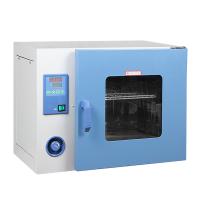
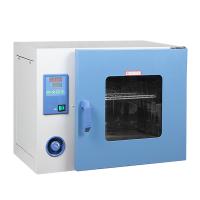
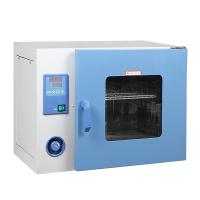
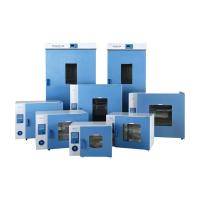
Vacuum Ovens can be used to dry heat-sensitive materials, including powders, to extract moisture. With vacuum oven drying, the boiling point is lowered; thus, the loss of compounds other than water is minimized.
The samples are dried under gentle heat with little residue. Some uses of vacuum ovens include moisture content determination, dry sterilization, purification and degassing of solids, etc.
Utilization of vacuum oven
Vacuum Ovens are adaptable tools that can be used in laboratory inspection engineering and industry. The low pressure environment also reduces oxidation during drying. Standard vacuum ovens can operate at temperatures as high as 200C to 250C.
There are several vacuum oven manufacturers and suppliers in India. In several factories, these ovens are designed in rectangular and cylindrical (circular) shapes and have a temperature range up to 150°C (optionally 200C).
Features of vacuum oven
Vacuum drying cabinets also have special features, such as solvent recovery or residual gas analysis, to prevent overdrying. For drying of flammable solvents, look for a safe vacuum Drying Oven that has been approved for this type of application.
Vacuum Drying Ovens carefully dry materials without damaging them in the process. The drying chamber reduces the pressure on the material throughout the drying process; thus, the material is able to dry at lower temperatures. For heat sensitive products. The craftsmanship is good.
Working principle of laboratory oven
annealing
The annealing process involves high heating and cooling of materials, such as glass or steel, to reduce hardness and increase ductility. High temperature ovens are used in this process, commonly used in applications in the metallurgy, medical device manufacturing and materials science industries. These annealed materials can be cut and shaped, making them easier to produce items such as syringes and catheters.
dry
Requirements of many environmental, organic and clinical laboratories: Utilize convection, forced air, and vacuum ovens to remove moisture from samples when drying them. Laboratory vacuum ovens are a good match for directly decomposed samples because these remove moisture and lower the boiling point of water, allowing samples to dry at lower temperatures.
At the same time, gravity convection ovens are often used to dry fine particles because these particles are prone to scattering under high air flow and require a more natural air flow to protect these delicate samples.