Why measure the coating thickness of stainless steel?
Stainless steel is often used to resist corrosion, making it a long-lasting and cost-effective choice. The chromium in stainless steel reacts with oxygen to form a thin, inert oxide layer over the entire surface that provides corrosion resistance and regenerates itself when damaged. In addition to its inherent corrosion protection, stainless steel is often coated to provide additional corrosion resistance or for decorative/aesthetic purposes.
Stainless steel is used in a variety of industries including construction, transportation, medical, energy, offshore oil, pipeline, aerospace and more. There are different stainless steel series with various combinations of added elements which are further divided into grades according to their composition.
Measuring the thickness of coatings applied to stainless steel substrates can be difficult with traditional hand-held inspection instruments, depending on the specific series and grade of magnetism.

Challenges of Measuring Coating Thickness on Stainless Steel Substrates
Depending on its grade, stainless steel can be magnetic, non-magnetic or partially magnetic. These magnetic properties need to be considered when selecting the appropriate coating Thickness Gauge. Using an incorrect gauge or setting may result in inaccurate coating thickness measurements.
Ferritic stainless steels are magnetic, including the 400 series grades, and have excellent corrosion resistance and ductility. Martensitic stainless steels comprise the 400 and 600 series grades and are also magnetic and have lower corrosion resistance than other series.
Austenitic stainless steels are commonly used and have the largest number of grades, especially the 200, 300 and 900 series grades. Steels in this series are generally non-magnetic. However, austenitic stainless steels become partially magnetic when cold worked. The specific material composition also affects the degree of magnetism, as does the addition of nickel.
Duplex stainless steels contain a blend of austenitic and ferritic stainless steels that offer higher levels of corrosion resistance and strength than the 300 series grades. This series is generally magnetic, but since duplex stainless steels have a higher austenite content than ferritic steels, they may be less magnetic.
For stainless steels that are slightly magnetic or have inconsistent magnetic levels due to varying degrees of cold work, making accurate coating thickness measurements and obtaining a repeatable zero can be difficult. Electronic coating Thickness Gauges using magnetic or magnetic induction methods rarely measure accurately due to weak and inconsistent magnetic fields. Similarly, Thickness Gauges using eddy current methods are also affected by magnetism in the substrate.
DeFelsko's Coating Thickness Measurement Solutions

Instruments designed to measure the thickness of metallic coatings operate either magnetically or eddy current, or both (a combination).
Magnetic - Measuring the thickness of non-magnetic coatings on magnetic substrates
Eddy current - measuring the thickness of non-conductive coatings on non-magnetic substrates
Measuring Paint Thickness on Magnetic Grades of Stainless Steel
Non-magnetic coatings applied to magnetic stainless steel substrates can be directly measured using a magnetic principle meter. Simply check the zero position on the uncoated section and adjust if necessary. * Available solutions include...
PosiTest - Magnetic pull-off Thickness Gauge (banana Thickness Gauge) for non-destructive measurement of non-magnetic coatings (paint, enamel, galvanized, metallized, electroplated, etc.) on steel.
PosiTest DFT - Dry Film Thickness Gauge measures paint and other coatings on metal substrates. This is the economical choice to preserve the uncompromising quality of DeFelsko coating thickness and inspection instruments.
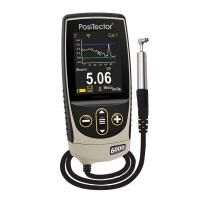
PosiTector 6000 F — The rugged, fully electronic PosiTector 6000 coating Thickness Gauge uses magnetic and eddy current principles to accurately and quickly measure coating thickness on ferrous and non-ferrous metals.
*For mechanical gauges, instead of checking zero before measuring, measure a known thickness on a bare substrate (such as a shim) to ensure the result is within tolerance.
Measuring paint thickness on non-magnetic grade stainless steel
Eddy current meters such as the PosiTector 6000 N (non-ferrous metals) are ideal for measuring non-conductive coatings applied to non-magnetic stainless steel substrates. Simply check the zero position on the uncoated section and adjust if necessary.
Measuring Paint Thickness on Parts of Magnetic Stainless Steel
PosiTector 6000 FN, including N-Lock (non-ferromagnetic lock) mode
The PosiTector 6000 FN (ferrous/non-ferrous) combination Thickness Gauge provides accurate coating thickness measurements on virtually all series and grades of stainless steel, including magnetic, non-magnetic and partially magnetic stainless steels. The PosiTector 6000 FN Gauge combines magnetic and eddy current technology to measure on both magnetic and non-magnetic substrates. Combination gauges first detect the presence of magnetism in the substrate and, if present, proceed to measurement using magnetic methods. If no magnetism is detected, the eddy current method is used. As with other gages, it is recommended to check for a repeatable zero on uncoated parts and adjust if necessary.
The PosiTector 6000 FN Gauge has the unique ability to overcome the measurement challenges posed by partially magnetic stainless steels, provided the applied coating is non-conductive.
The PosiTector 6000 FN instrument has an N-Lock (non-ferromagnetic locking) mode, which makes the gage exclusively use the eddy current measurement principle. A rare-earth magnet within the probe saturates the weak magnetic field that would otherwise interfere with eddy current measurements, effectively turning part of the magnetic substrate into a temporarily non-magnetic substrate. The gauge will then be able to obtain accurate and repeatable readings of stainless steel coating thickness regardless of inconsistent or partial magnetism.