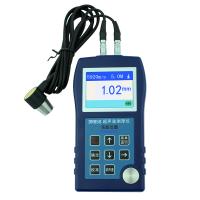
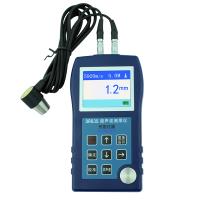
High temperature thickness measurement occasions
Towers, tanks and pipelines in petrochemical, oil refining, chemical, pharmaceutical and other industries.
During service operation, the medium (whether it is liquid or steam) in the pipeline of these containers is in a high temperature state, and it is conducted to the outer metal wall, and the temperature is still hundreds of degrees.
Corrosion is exacerbated by high temperatures, and the flow of media is driven by pressure. Therefore, there is a need to monitor the degree of wall thickness reduction in these vessels, especially at bends in pipes and elbows in valve bodies such as T-shirts.
The principle of piezoelectric ultrasonic thickness measurement
Main points:
Since the ultrasonic waves generated by piezoelectricity are difficult to propagate in the air, it is necessary to apply a coupling agent between the probe and the surface to be measured to "squeeze out" the air gap so that the ultrasonic waves can effectively propagate to the part to be measured and obtain the bottom surface (that is, the inner wall the reflected signal);
The reflected signal needs to be stable, clear, and clear enough for the instrument to recognize and count to display the thickness value.
Influencing factors of high temperature measurement
Couplant, probe, the condition of the surface to be measured, the material of the object to be measured, and the instrument.
About Couplant
At high temperatures, the moisture in the couplant evaporates immediately, thus losing the effect of "squeezing out" the air gap. Therefore, the instrument can only "see" the fleeting reflection signal, and it is often too late to identify and calculate it.
In order to protect the bottom surface of the probe from being "scalded", the so-called ultra-high temperature couplant is often mixed with some mineral particles to ensure that the bottom surface of the probe does not directly contact the high-temperature measured surface, but this will also cause the mineral particles to be exposed to high temperature (coupling) Down. After the moisture of the agent evaporates instantly, it is easy to carbonize and stick to the bottom of the probe, which will affect the measurement (equivalent to the "pocket" at the bottom of the probe).
About Probes
The probe has a built-in "crystal oscillator" that generates and receives ultrasonic signals. The crystal oscillator chip has a physical parameter, "Curie temperature point Tc", which means that below this temperature value, the ultrasonic wave generated by the crystal oscillator chip has an appropriate acoustic impedance, that is, the difficulty of propagation is appropriate. Crystal oscillators made of different materials have different Tc values.
In existing crystal oscillator materials, Tc values can reach 500°C, but another parameter, the "mechanical quality factor θm", is very high, reaching the 6th power of 10, which makes it impossible to obtain effective signal resolution Ratio——The θ m of the crystal oscillator used in the ultrasonic Thickness Gauge is all lower than 1000, otherwise the starting point of thickness measurement needs to be above 500mm.
Therefore, the existing so-called "high temperature" probes cannot make breakthroughs in essential crystal oscillators. The current solution is only to protect the probe itself (for example, the protective film at the bottom of the probe is not easy to be "burned". ", put a protective cover on the casing, etc.), there is no way to solve the problem of effective propagation of piezoelectric ultrasonic signals in high-temperature media (transmission and receive) issues.
About the state of the surface being measured
When the probe is placed on the surface of the surface to be measured, the ultrasonic wave propagates in the direction perpendicular to the tangent of the contact point, and the bottom surface (inner wall) is also reflected in the direction perpendicular to the tangent. This effect is good. This effect is relatively easy to achieve in planar measurements as well as measurements on large diameter cylinders, pipes and tanks. But with curves and bends (especially 90 degree bumps) it's often difficult to get the probe right.
In addition, in the field environment, oil stains and paint (especially bumps) on the surface to be measured can affect the measurement.
About the material of the measured object
In any case, the transmission of ultrasonic waves will be affected by the material of the object under test, resulting in scattering effects and changes in the sound velocity. In most cases, however, these effects cause little disturbance and cause small errors that are negligible.
However, due to high temperature and high pressure corrosion resistance, the impact on some parts materials cannot be ignored. For example, stainless steel valve bodies of different specifications and grades have different degrees of signal scattering attenuation.
General Questions About Instruments
The usual ultrasonic Thickness Gauge is a reading type - after detecting a stable, clear and clear reflection signal, it calculates and displays the result.
In the high temperature state, due to the above factors, the reflected signal is unstable, clear and clear, and the instrument cannot detect the signal or detects the wrong signal, so "no reading value" and "reading value error" appear. And so on.
About the main solution of the instrument
The original instrument could only detect four signals. Now, let it detect the signal 20 times, this is the scanning function; at the same time, it displays the maximum or minimum value detected by the scanning, which is called "extreme value display".
If the signal is too weak, increasing the signal, called "gain adjustment", is adjusted digitally, not in steps;
Because the signal appeared to be very short, he disappeared as soon as the instrument finished reading the signal, and the instrument was not sure. Then let it show the read signal first, this is called "read value hold".