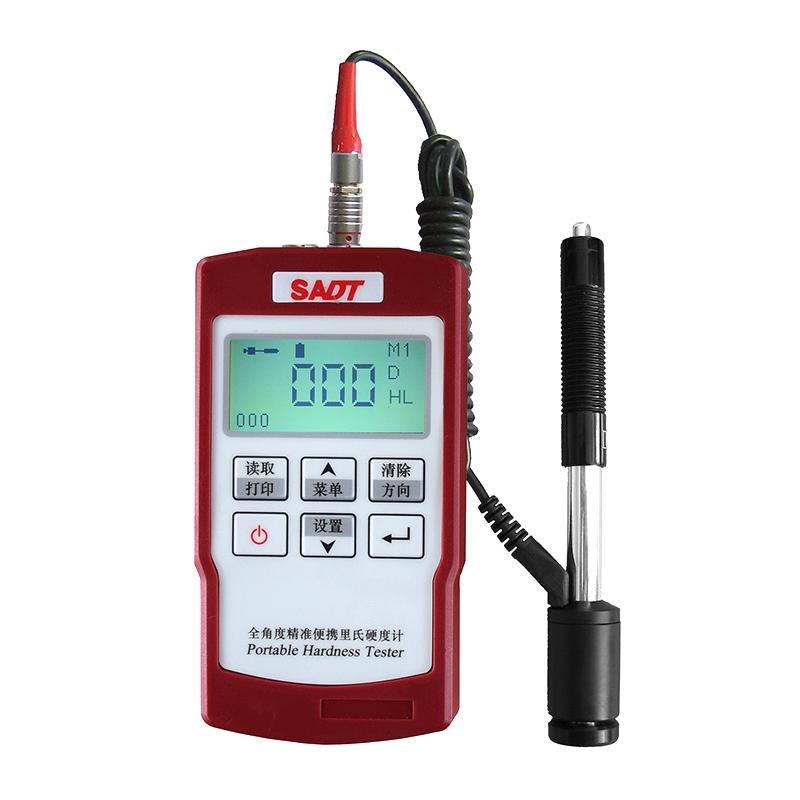
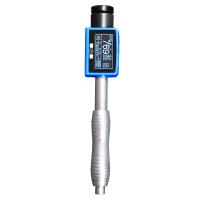
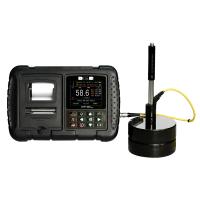
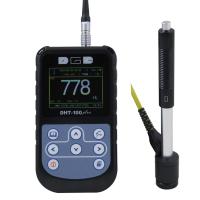
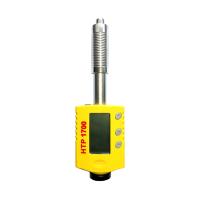
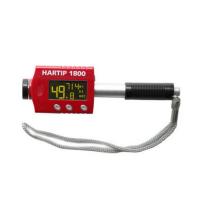
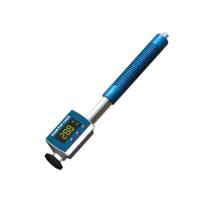
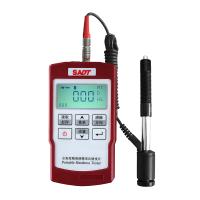
Leeb hardness testing technology is a newly developed technology after Brinell hardness, Rockwell fiber, Vickers hardness and Shore hardness. The Leeb Hardness Tester manufactured according to the Leeb hardness theory has changed the traditional hardness testing method. Since the hardness sensor is as small as a pen, holding the sensor can directly test the hardness of the workpiece in all directions on the production site, so it is difficult for other desktop Hardness Testers.
What is the Leeb hardness
The concept of Leeb hardness was proposed by Dr. Dietmar Leeb of Switzerland, which is a dynamic hardness testing method. During the impact process between the impact body of the hardness sensor and the workpiece under test, the ratio of the rebound velocity to the impact velocity at a distance of 1 mm from the workpiece surface is multiplied by 1000, which is defined as the Leeb hardness value. The Leeb hardness is expressed in HL. The formula is as follows:
HL=Vb/Va×1000
Vb: Indicates rebound speed
Va: Indicates impact velocity
The characteristics of the Leeb Hardness Tester
Both the Shore hardness and the Leeb hardness adopt the dynamic load test method, but the Shore checks the vertical height of the rebound of the impact body, so it is determined that the Shore Hardness Tester should be used vertically downward, which is limited in some applications. However, Leeb hardness is different. The Leeb Hardness Tester checks the speed of rebound and the impact force of the impact body. With speed correction, it can be used in any direction, which greatly facilitates users.
Brinell Hardness Tester, Rockwell Hardness Tester and Vickers Hardness Tester are commonly used. Due to its large size, it is inconvenient to use in the field, especially when large and heavy workpieces need to be tested. Since the bench Hardness Tester cannot accommodate it, it cannot be detected at all. The Leeb Hardness Tester does not need a workbench, and its hardness sensor is as small as a pen, which can be directly operated by hand. It can easily detect whether it is a large, heavy workpiece or a workpiece with complex geometries.
Factors Related to Leeb Hardness
Since the Leeb hardness test method is a dynamic load test method, the Leeb hardness value needs to be related to the elastic modulus E of the metal material. The elastic modulus corresponding to different materials is also different, so the Leeb Hardness Tester is classified and tested according to the type of material.
Conversion of Leeb hardness and other hardness
There is a correspondence between the Leeb hardness value and other hardness values (HRC, HRB, HB, HV, HSD). Therefore, the Leeb value (HL) can be converted to other hardness values. The Leeb Hardness Tester can be automatically converted by the built-in microcomputer.
Classification and comparison of Leeb hardness and other hardness and testing requirements
From the perspective of microscopic deformation, Brinell, Rockwell and Vickers hardnesses examine the plastic deformation of materials, which is expressed as the size or depth of the indentation; Leed and Shore hardnesses examine the elastic deformation of materials, which is expressed as springback The magnitude of the velocity or the depth of the indentation.