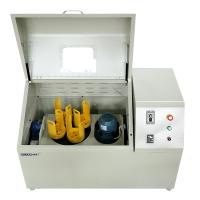
The following factors are studied and applied in conventional ball milling to maximize grinding efficiency:
a) Mill geometry and speed
observed that grinding efficiency is a function of ball mill diameter and established an empirical relationship for recommended media size and mill speed that takes this into account. Likewise, for a given power rating, mills with different length-to-diameter ratios will produce different material retention times, with longer units for high reduction rates, and shorter units where overgrinding is a concern. Also relevant to material and media retention are discharge arrangements. Experience in South Africa has shown that the faster the pulp removal, the better, as evidenced by the evolution from the grate with pulp riser to the perimeter and finally to the open discharge design
b) Feed preparation
With the widespread use of coarse ball mills, it is becoming more and more important to provide a suitable high-end feed to the ball mill. Seriously inefficient since larger (and thus fewer) grinding balls are required. Furthermore, since mill performance is related to the complete size distribution of the feed, all stages of crushing and classification that affect the particle size distribution of the feed have an impact on the performance of the Grinder.
c) closed circuit grinding
Closely related to the ball mill's ability to perform efficiently on a particular material size distribution is the observed increase in grinding efficiency with increasing cycle load and classifier efficiency. Increased cycle duty reduces overgrinding and provides media with an effectively narrower size distribution. However, it encounters diminishing returns in terms of grinding efficiency and reaches practical limits due to material handling and sorting requirements.
d) Feed composition
In addition to the ore itself, the feed to the ball mill may contain one or several other components. Common among these is water, which exhibits various effects on the grinding process, depending on the nature of the material and the percent solids of the mixture. Dry grinding can require 10% to 50% more power than wet grinding, although this is offset by greatly reduced media and pad consumption. Introducing a few percent moisture without heated gas sweeping can nearly stop grinding of fine material until increased water addition takes the material through the viscous stage to sixty to eighty percent solids by weight normal wet grinding range. Within this range, the optimum water content for effective grinding is generally determined by the combined influence of many common conditions, such as pulp viscosity, mill residence time, internal friction and filling of charge gaps, material transport characteristics, and mill physical design parameters.
e) Media Utilization
The practice of matching the material size distribution to the effective media size distribution is widely used and involves media top size selection as well as graded ball charging. Large balls are more suitable for coarse grinding, and the principle of small balls for fine grinding is also applied in the cement industry, by media classification inside the mill, either with a classifying head or with a classifying liner.
The choice of grinding ball material is usually evaluated based on the cost-effectiveness of media consumption. However, increases in specific gravity and surface hardness have also been reported to show significant improvements in grinding energy usage and are clear areas of interest for further research.
f) Control technology
With few exceptions, grinding circuits will be exposed to changes in feed characteristics that cause the current operating conditions to continuously deviate from the best conditions. Due to the frequency of these changes and the response time and reliability of human operators, automated control systems have been applied and reported energy efficiency improvements of 15%, and current research into superior control strategies promises further improvements.
Grinding mechanisms in ball mills can be broadly classified as impact or abrasion, with at least two forms of breakage for each type. Impact fracture occurs as particles are crushed between the balls or between the balls and the mill liner, but is also generally defined to include slow compression fracture, or crushing of particles between grinding media. In either form, impact milling exhibits a range of sizes in the product particle, with the parent matrix virtually disappearing. Grinding involves abrasion, the removal of the surface of a particle by frictional action, and the cutting of fragments by a force that cannot destroy the entire particle. Typical features of both consumption behaviors are the production of small daughter particles and the survival of reduced but recognizable parent bodies. (Note that the meaning of "wear" as used here is adapted from the above reference, not the one sometimes used to describe autogenous grinding mechanisms).
The size of the efficiency effect of better utilization of grinding mechanisms should not be underestimated. For example, Turner (1979) has shown that in autogenous mode, by adding balls of an extremely difficult to grind ore, the total capacity is increased by nearly 800%, and attributes the increase in efficiency to (a) the impact action of the balls, and ( b) Increased use of abrasive forces over the larger surface area created in (a). The same sources of synergy found in Turner's "Optimized Load" principle can also be applied to ball milling through the proper application of the grinding mechanism and other factors that affect ball mill efficiency as previously described. While the examples of increased efficiency in ball mills may be far less dramatic, they are just as important in their own right.