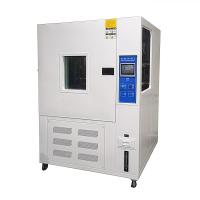
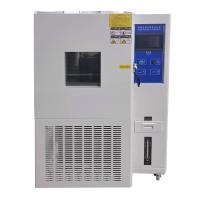
Testing humidity at very high temperatures helps manufacturers determine the strength and response of components to different and harsh environmental conditions, including high temperatures, fluctuating atmospheric conditions, and high relative humidity. This test can only be carried out under static temperature and humidity conditions where the material is subjected to a period of time, and it can also be carried out under dynamic test conditions where different moisture percentages are likely to cause product failure.
Is it possible to create humidity without controlling temperature conditions?
Researchers often ask questions like this. Without controlling the temperature of the chamber, it is difficult to precisely control the humidity and high repetition rate of the chamber. If the user really wants a dry and high-humidity environment, then ignoring the temperature controller settings can also seriously affect the accuracy and results of the humidity.
The relationship between temperature and relative humidity
Temperature and humidity are directly proportional. The high temperature of the chamber results in high humidity and humidity in the chamber, which means the air is able to handle more moisture for a given temperature. Relative humidity is the ratio of the moisture in the air to the strength it can hold at a given temperature. This means that as the temperature of the chamber increases, so does the percentage of humidity in the chamber, and a steady temperature will provide a steady humidity.
How is humidity produced?
There are various methods that can be used to generate humidity or moisture in a chamber within a laboratory to examine the effect of humidity on different products. Here we will discuss in detail the different ways humidity is produced.
steam generator
A steam generator is a tank instrument with a heater. As the temperature in the room rises, the Water Tank is heated and the steam generated in the Water Tank rises to the top of the chamber where the heater or cooling coil is installed/Steam generation tank works according to the output it is supplied by the heater and generates humidity. A good example of a steam generator is an autoclave. Steam generators are used in various production verticals due to their various advantages.
Easily generate large volumes of steam in large chambers
The quality of the water vapor is consistent.
sprayer
A nebulizer is a widely used humidity generator that consists of a nozzle that sprays atomized water to create moisture and humidity inside the instrument. According to the working principle of the atomizer, when the water passes through the chamber heater, it will be heated immediately. These types of machines are used in laboratories to generate high levels of heat and provide many benefits. The main advantages of nebulizers are as follows:
Easy to operate and simple system
more power saving
rapid cooling air
enough to produce a lot of moisture
no problem with the heater
Water Bath
Another method used to create humidity and serve as a steam generator is a Water Bath. A Water Bath is a small chamber, suitably equipped with cooling coils and heaters. As air is drawn into the assembly housing the coil and heater, it passes through the bath and absorbs the air. The main advantages of using a Water Bath indoors include:
The device is very responsive as it requires a small amount of water to create humidity
No need for a boil procedure to create moisture or humidity.
Less boiling means the chamber requires relatively little maintenance
Allows for quick inspection and cleaning.
Determining the Effect of Humidity on Different Products
The different conditioning chambers are designed with excellent technology to generate different temperatures and humidity inside the cabinet. These chambers are designed with good glass wool to ensure less heat loss rate than to ensure insulation inside the chamber. The chamber consists of a heater and a cooling compressor to maintain an accurate humidity level in the chamber. Humidity chambers, also known as conditioning chambers, are used in testing laboratories to measure the effect of different atmospheric conditions on the mechanical, chemical and physical properties of products under actual working conditions.
Using Humidity Chambers in Different Verticals
Humidity chambers are widely used in high-volume production verticals to ensure the impact of the environment on different products.
Rubber Industry - Determining the cracking or melting properties of rubber in hot and cold environments.
Pharmaceutical Industry - Analyzing the effect of humidity on pharmaceuticals.
Plastics Industry - Measuring the effect of humid conditions and high temperatures on the mechanical and physical properties of plastic products.