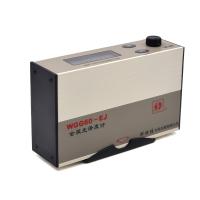
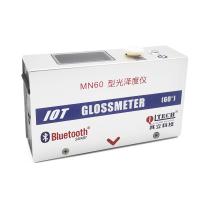
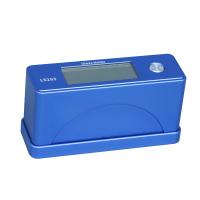
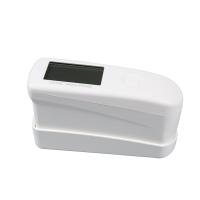
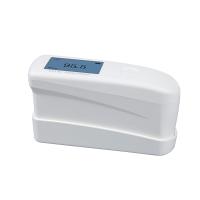
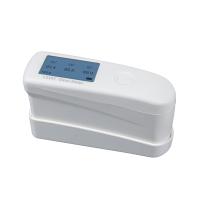
The measurement of gloss is an essential control value in many production departments to determine how light is reflected when it falls on different surfaces and to guarantee the quality of the product. Therefore, gloss meters of different geometries are widely used in industrial fields where the analysis of this optical property is very important. Specifically, a 75º geometric gloss meter is recommended for measuring the gloss of paper, cardboard and vinyl.
What is gloss?
According to the standard UNE-EN ISO 8254-1:2009, gloss is "the aspect by which light reflected from an object is perceived as superimposed on the surface due to the directionally selective properties of the surface".
In this way, gloss is associated with our visual perception, which has a psychological effect on consumers.
When light hits a surface, diffuse reflection and specular reflection occur. In the first case, the light rays are emitted in different directions, while in the second case, the light rays are reflected at the same angle or direction as the incident angle. Now, while the diffuse reflection is responsible for the color of the object, the specular reflection is responsible for the glossy effect. Therefore, we can say that gloss is an optical property of a surface characterized by its ability to reflect specular light.
In materials with rough and non-smooth surfaces or finishes, the amount of diffuse light will be greater than the amount of direct or specular light. Therefore, we have matt, low-gloss or semi-gloss surfaces.

On the other hand, in polished and smooth surface finishes, the proportion of direct light reflection is greater because the light is directly reflected at the same angle of incidence. In this case we have high gloss surfaces or surface treatments.
Like color, gloss is an essential parameter for assessing the appearance of a product's surface, an attribute that is considered when creating quality controls for both design and production processes.
Therefore, it is very important to measure gloss objectively and quantitatively using a gloss meter. These teams are often used by companies in industries such as paper, plastics, automotive or paints and varnishes.
75º gloss meter

One of the factors to consider when measuring gloss is the angle of incidence or observation.
In industries such as automotive, ceramics, furniture, plastics, paints and coatings, metals or building materials, the recommended gloss measuring instrument geometry is 20º, 60º or 85º, depending on the type of reflectance of the surface.
However, for the field of paper and graphic arts, they are generally recommended, the 75º gloss meter.