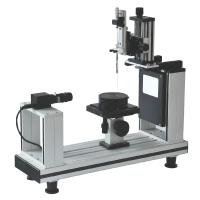
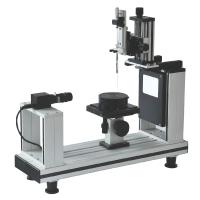
Measurement consists of two steps: recording and analysis. The equipment required to perform contact angle measurements is very simple. A common approach uses three basic components:
a light source
camera
tilted stage
The measurement process is as follows:
The platform is flat so the droplets do not move during deposition.
A drop of liquid is deposited on the platform.
The droplet is illuminated from behind and the image is recorded by a camera.
Use the code or software to analyze the images and determine the contact angle measurements.
Recording images of contact angle measurements
The first step in the measurement is to acquire an image of the droplet on a flat surface. When designing the optics for a measurement system, several factors need to be considered. Optics can add significantly to the cost of your setup, even though they are sometimes unnecessary.
Let us consider a photograph of a droplet on a substrate. What are the important aspects of the image for our measurement purposes?
size of the picture
Remember: the image needs to contain the entire drop; you cannot measure the contact angle without seeing the edges!
clear
You need to be able to see the droplets clearly. The better the edge definition, the more accurately you can measure the contact angle. A "blurred" droplet edge can make it harder to see the slope of the droplet and where it meets the solid surface.
Sharpness may be affected by factors such as camera resolution, image magnification, light level and contrast with background.
camera resolution
The camera resolution determines the number of pixels that represent the edge of the droplet. If the image is highly pixelated, it can be difficult to determine where the edge of the droplet is. For polynomial fits (discussed later), the fewer data points, the less accurate the fit.
enlarge
Image magnification has an effect on resolution. The larger the optical image, the more pixels it will cover, and the higher the resolution of the image.
Compared
Contrast is important to find the edge of the droplet. If the contrast is low, it will be difficult to separate the droplet from its background. If you use edge detection techniques, the contrast will determine the detection accuracy.
light
Light levels can also affect measurements. You need to be able to see the droplets to take measurements. If the light is too bright or too dark, the contrast between the water droplets and the background will suffer.
depth of field
You want the entire depth of the droplet to be in focus, otherwise it's hard to find the baseline through the blurry front of the droplet. This can be achieved by changing the "depth of field" of the imaging system. The actual focal point of the lens has a specific distance from it. However, there is an area on either side of the focal point that you consider to be in focus. This is called "depth of field". Depth of field can be changed by using aperture. The image below shows the effect of aperture on the light entering the camera. As the aperture size decreases, the light entering the camera narrows.
This resulted in two changes:
There is less light overall, so you need a bright background light.
The depth of field increases and the "focus" area becomes longer.
As the aperture narrows, the size of the beam changes. If you think the focal area is within a certain beam width, you can expand that focal area away from the camera by shrinking the beam. The result is shown in the figure above. In the first image, the depth of field starts and ends inside the droplet, so the front and back of the droplet are blurred. In the second image, the depth of field is wider than the entire droplet, so the entire droplet is in focus.
analyze
After an image is acquired, most contact angle measurements follow four basic steps:
define baseline
The baseline of the measurement is the horizontal line representing the solid on which the droplet is deposited. The contact angle is the angle at which this baseline meets the edge of the drop.
Tracking Droplet Edges
The contact angle cannot be calculated without knowing the position of the drop edge relative to the baseline. Droplet edges can be drawn manually, detected programmatically, or estimated based on some assumptions about typical droplet shapes.
determine the gradient
Next, you need to determine the tangent gradient of the droplet edge where it intersects the baseline. As with edge tracking, this can be done manually with a protractor or programmatically using software.
Calculate contact angle
Once you have the baseline and gradient, you can calculate the angle between them. For this, you can use trigonometric functions. For example, if the gradient is 3, then you can use the relation tan(θ) = (opposite/adjacent) = (3/1) to calculate the angle. Once you have the baseline and the edge of the droplet, you can calculate the angle between them.