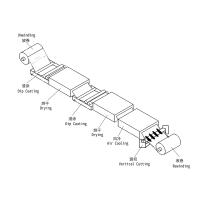
Exit and Film Formation
The exit phase of the dip coating process can be simply viewed as the interaction of several sets of forces. These forces can be classified into one of two categories: displacement and entrainment. Drainage draws liquid away from the substrate and back into the bath. In contrast, entrainment forces are the forces that hold the fluid to the substrate. The balance between these forces determines the thickness of the wet film applied to the substrate. During the withdrawal phase, the formation of wet film can be divided into four regions
The four regions are:
Static meniscus, where the shape of the meniscus is determined by the balance of hydrostatic and capillary pressures.
A dynamic meniscus, which occurs near the point of stagnation. The stagnation point is where the entrainment and expulsion forces balance.
Constant thickness region, where the wet film has reached a given thickness (h 0 ).
The wetting zone, the area where the wet film begins.
The dynamic meniscus and solution flow in this region determine the wet film thickness. Therefore, it is important to understand the physics underpinning dynamic meniscus curvature and stagnation point thickness.
A stagnation point occurs when the balance between entrainment and expulsion forces is equal. It is the balance of these forces that determines the thickness of the film. There are three distinct coating regimes, defined by which forces govern the behavior of the coating - these are the viscous flow, draining and capillary regimes.
Viscous Flow and Drainage Systems
The first coating method is the viscous flow method. This occurs at high velocity and in viscous solutions. Here, the coating is mainly affected by viscous and gravitational forces. In this case, the thickness of the liquid layer can be given by Equation 1.

Here, entrainment forces consist of viscous forces acting on the solution when removing the substrate. This is given by the viscosity (η) and the withdrawal velocity (U 0 ) of the substrate from solution. The drainage force is the force of gravity, given by the solution's density (ρ) and gravitational constant (g). The constant (c) is related to the curvature of the dynamic meniscus. This constant is a characteristic of the solution itself and is closely related to the rheological properties of the solution. For most Newtonian liquids, this constant is around 0.8.
In most cases, the extraction rate or viscosity of the solution used is insufficient to make this approximation valid. When these two variables decrease, the viscous force becomes weaker. The balance between entrainment and expulsion forces also depends on the surface tension of the solution to drive the motion. It is under these conditions that the coating is considered to be draining. The Landau-Levich equation (see Equation 2) describes the relationship between wet film thickness and substrate withdrawal velocity (when taking surface tension into account).
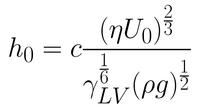
The Landau-Levich equation is valid until very low withdrawal rates are considered. A third coating occurs when the velocity decreases below approximately 0.1 mm.s -1 . This state is called capillary state. In the capillary regime, the rate at which the solution is entrained onto the substrate (by viscous flow) is lower than the rate of evaporation. Therefore, the importance of drying kinetics for understanding the capillary state cannot be overstated.
drying kinetics
Dip coating typically has three distinct drying stages:
The Drying Front During the Painting Process
fixed rate period
interest rate cut period
The simple drying stages are the constant rate period and the falling rate period. Constant rate cycles occur in constant thickness regions (during and after coating). Here, the evaporation of the solvent occurs at the surface of the wet film and occurs uniformly across it. An exception is at the edge of the substrate where the drying front occurs.
Over time, most of the solvent will be removed from the wet film until a gel-like film forms. This is when the drop rate cycle occurs. During the falling rate, a small amount of residual solvent is trapped in the gel - evaporation depends on the diffusion of the solvent to the surface.
A more complex drying phase occurs at the drying front, as shown in the figure below. The drying front occurs at the interface between the wet film and the substrate - evident in the wetted zone. Evaporation occurs here faster due to the greater surface area to volume ratio, resulting in the formation of a wet film with a higher concentration. This causes the solution to be drawn from the surrounding area due to the surface tension driven effect. Once the solution at the drying front forms a dry film, capillary forces are exerted on the solution. This causes the solution to wick into the dry film - resulting in a thicker deposited film.
The absorption of the solution into the dry film (due to capillary forces) occurs during the capillary state of the coating. For sufficiently fast extraction rates, the drying front recedes significantly slower than the formation of constant thickness zones. Therefore, the drying kinetics are governed by a constant rate cycle and the film thickness will depend on the initial wet film thickness. For slow withdrawal speeds (where the drying front recedes faster than the withdrawal speed), the drying kinetics are dominated by the drying front.
capillary mechanism
In the capillary state, the wet film thickness is not considered. This is because constant thickness regions are never really achieved at these coating speeds. Thus, in the capillary state, the thickness depends on i) the rate of withdrawal, ii) the nature of the solution, and iii) the rate of evaporation of the solvent. Therefore, the dry film thickness is given by Equation 3.

Here, the evaporation rate (E), film width (L), extraction rate (U 0 ) and material proportionality constant (K) determine the dry film thickness (hf ). K is a combination of solute, solution, and dry film properties. This constant depends on the total concentration of the solute in solution (c), the molar weight of the solute (M), the density of the solute (ρ), and the porosity (α) of the deposited film.
Properties such as solute concentration, solute density, and molecular weight of the material have simple but obvious effects on dry film thickness. However, porosity values are much more complex. Porosity not only changes the density of the film compared to the raw material itself - it also affects drying dynamics. As mentioned before - at the drying front, at the point of contact between the dry film and the wet film, the wet film will be drawn into the dry film by capillary action. The porosity of the film also has a big impact on this, it determines how quickly the solution is drawn into the dry film, how far the solution travels into the dry film, and how quickly the absorbed material dries.
Film thickness and drawing speed
Dry film thickness as a function of pull-off speed requires the use of the Landau-Levich equation and the capillary equation of state. The figure below shows an example of a plot of withdrawal speed versus film thickness for a dip coating process. The minimum thickness for dipping is achieved in a crossover process between these two coating schemes. As the exit velocity deviates from the minimum in either direction, different coating schemes dominate.
For high-low speeds, the thickness profile can be given by the Landau-Levich equation or a separate capillary equation of state. However, for a range of coating velocities, neither equation alone can give an accurate value for coating thickness. This occurs at the absolute minimum of the coating thickness. To calculate the minimum thickness, you need an equation that unifies the Landau-Levich and capillary equations of state.
minimum film thickness equation
To determine the minimum thickness, a combination of equations governing thickness during the drained state and the capillary state is required. The first step is to modify Equation 2 to relate wet film thickness to dry film thickness. This can be done simply by including the "Material Scale" constant in the equation.
Adding the two equations yields Equation 4. Here, the first term in parentheses is related to the capillary state (Equation 3), while the second term is related to the drainage state (Equation 2). The constant in Equation 2 has been transformed into the general solution constant (D).

From this equation, the minimum film thickness can be determined by differentiating the thickness. By setting this derivative to 0 (which is the gradient at the inflection point of the minimum), you get Equation 5.

While this equation gives an approximation of the actual film thickness, there are several influencing factors that have not been considered. These include surface air flow, variable evaporation rates, viscosity and concentration gradients, thermal gradients, Marangoni flow, and other parameters that may vary over time.
change withdrawal speed
The meniscus is defined by two main forces:
Gravity-Based Viscous Drag
Surface forces between substrate and solution
During withdrawal of the substrate, the solution in the meniscus (hereafter referred to as ink) either falls back into the reservoir or is pulled up with the substrate to form a thin film, as shown in the figure below. The menisci terminate at the dry line. This is the point at which all solvent evaporates or drains, leaving behind a solid film. The moving speed of the drying line is the same as the take-out speed. As the substrate is withdrawn, the meniscus stays near the substrate-reservoir boundary, effectively "moving down" the substrate. For dip coating, there are two main regions defined by the extraction velocity: the capillary region (low velocity) and the discharge region (high velocity).
In the drainage area, the withdrawal speed is higher than 1 mm/s. The drying line moves faster than the solvent can evaporate. Here, according to the Landau-Levich model, the film thickness is controlled by the ink properties and the withdrawal speed. Evaporation rate is not important here.
In the capillary region, the withdrawal velocity tends to be lower than 0.1 mm/s. The key factor here is that the evaporation is faster than the "movement" of the drying line. Here, the solvent evaporates once the ink is fed into the upper part of the meniscus. It is then replaced as surface forces pull more ink onto the substrate - and the solvent evaporates again. This is capillary feeding. Therefore, in this region, the lower the pull-out speed, the thicker the film.
Between these there is an area that can be accurately modeled by a combination of the above models. This region produces the thinnest film and defines the V-shaped dependence of thickness on pull-off speed, as shown in the figure below. Working in the capillary region can cause some of the problems outlined in this guide - so use higher extraction speeds if possible. However, if the coating ink is very dilute, it may be necessary to use a low exit speed to obtain an even coating.